AKREDITASI
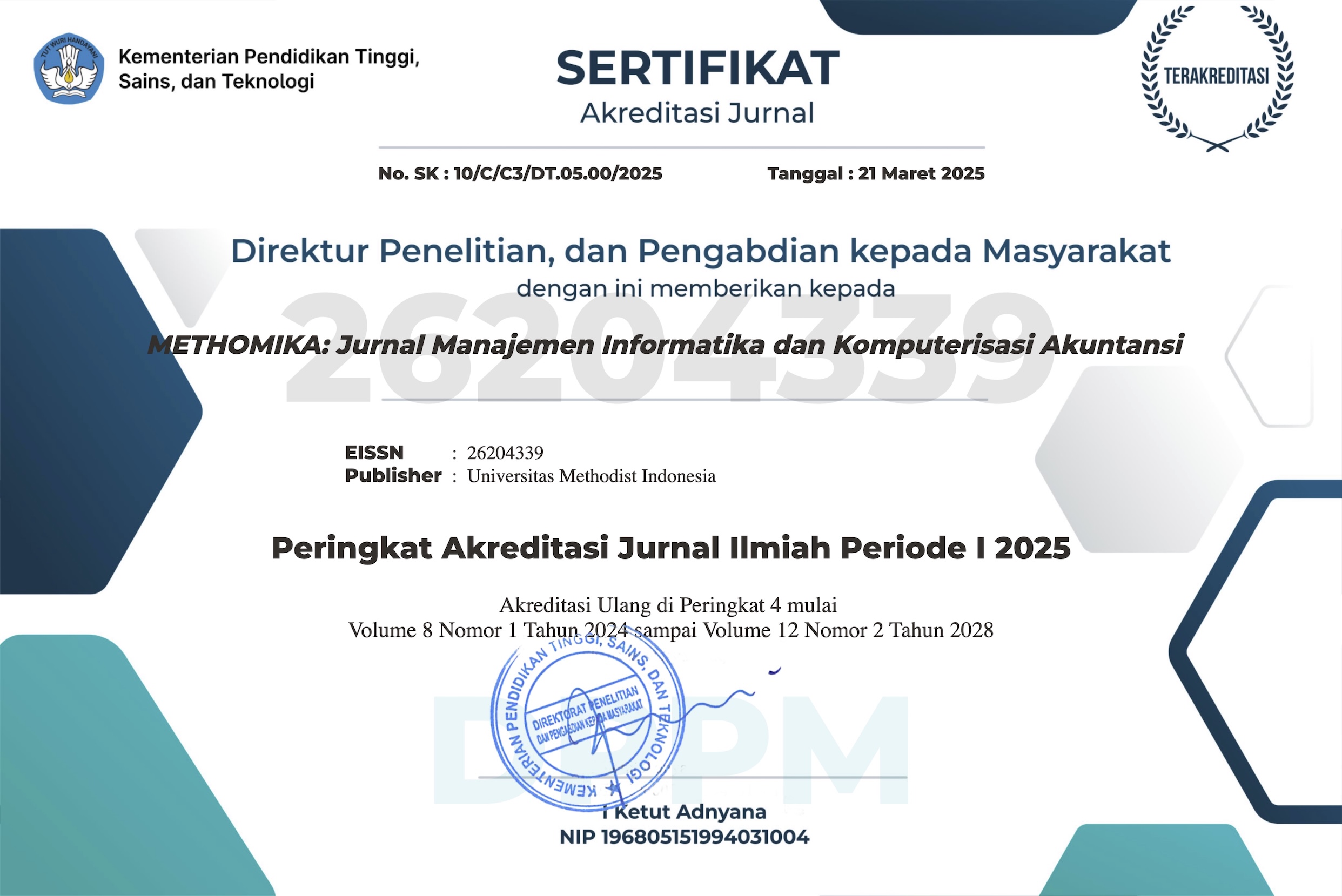
Sertifikat Akreditasi

METHOMIKA | EDITORIAL POLICY
Allegations of Research Misconduct: Fair Assessment, Research Integrity, and Responsible Editorial Action.
METHOMIKA: Jurnal Manajemen Informatika & Komputerisasi Akuntansi, published by Universitas Methodist Indonesia, is committed to maintaining integrity, honesty, transparency, and accountability throughout the research and scholarly publication process.
The journal takes allegations of research and publication misconduct seriously, whether they concern submitted manuscripts or published articles. Allegations must be assessed fairly, objectively, confidentially, and on the basis of relevant evidence.
This policy is informed by the principles and guidance of the Committee on Publication Ethics (COPE), particularly those concerning allegations of misconduct, cooperation with research institutions, and the integrity of the scholarly record.
Research and publication misconduct may include, but is not limited to, the following practices:
Inventing research data, observations, experiments, measurements, or results that were not actually obtained.
Manipulating research materials, datasets, methods, instruments, images, or results in ways that misrepresent the research findings.
Presenting another person's ideas, words, methods, data, images, software code, or scholarly contributions without appropriate acknowledgment or attribution.
Publishing or submitting substantially overlapping research without appropriate disclosure, attribution, or a valid scholarly justification.
Inappropriately including or excluding individuals from authorship, misrepresenting author contributions, or engaging in gift, guest, ghost, or coercive authorship practices.
Inserting irrelevant or unnecessary citations to artificially influence citation metrics or benefit particular individuals or publications.
Submitting fraudulent reviewer identities, interfering with independent peer review, or manipulating reviewer reports and editorial evaluations.
Conducting research without required ethical approval, violating informed consent requirements, misusing confidential information, or improperly processing personal data.
Deliberately concealing relevant financial, professional, personal, or institutional relationships that could materially affect research or editorial decisions.
Using AI-assisted tools to fabricate data, generate fictitious references, conceal plagiarism, create misleading research images, or misrepresent scientific findings.
Allegations of misconduct may be submitted by authors, reviewers, editors, readers, academic institutions, research participants, or other individuals who possess relevant information.
A report should, where possible, include:
Reports may be submitted through the journal's official editorial communication channels. Anonymous reports may be considered when they contain sufficiently specific and verifiable information. An allegation alone does not establish that misconduct has occurred.
The editorial office receives and documents the allegation, including the available supporting information and relevant manuscript or article records.
The editor assesses whether the report contains specific information relevant to research or publication integrity and whether additional clarification or evidence is required.
Editorial personnel with relevant competing interests are excluded from handling or deciding the case. An independent editor should be assigned when necessary.
Where appropriate, the parties concerned are invited to respond to the issues raised and provide relevant explanations, records, or supporting documentation.
The editorial team assesses relevant manuscripts, research documentation, similarity reports, reviewer records, publications, and other available evidence. Independent expert advice may be requested when necessary.
Serious allegations requiring examination of research conduct, laboratory or institutional records, or individual responsibility may be referred to the appropriate research institution for investigation.
The editor determines appropriate action within the journal's authority, taking account of the available evidence, relevant institutional findings, and applicable publication ethics guidance.
Relevant correspondence, evidence, decisions, and follow-up actions are documented securely. Additional steps may be taken if new material information becomes available.
If an allegation is received while a manuscript is under editorial assessment or peer review, the editorial team may suspend further processing while relevant concerns are evaluated.
Depending on the findings, editorial actions may include:
Manuscripts must not be accepted solely because no formal institutional finding has yet been issued. The editor should consider whether unresolved concerns materially affect publication reliability.
Allegations concerning published articles are assessed in accordance with the journal's Publication Ethics and Correction and Retraction policies.
The journal may consider the following actions when supported by the evidence:
A correction may be issued when a significant error requires amendment but the central findings remain sufficiently reliable.
An expression of concern may be issued when substantial unresolved questions warrant alerting readers while further investigation or clarification is ongoing.
Retraction may be considered when findings are unreliable, serious plagiarism is established, or other circumstances satisfy accepted retraction criteria. The purpose is to correct the scholarly record.
Formal post-publication notices should identify the affected article, describe the reason for the action, and remain accessible to readers.
Research institutions have an important role in investigating allegations that require examination of researcher conduct, primary data, laboratory records, institutional permissions, or other information beyond the journal's authority or access.
METHOMIKA may communicate relevant concerns and supporting information to authorized institutional representatives when appropriate and consistent with confidentiality obligations.
Institutional investigation and editorial decision-making have distinct purposes. Institutions address research conduct within their authority, while the journal determines actions required to protect the scholarly publication record.
Authors are expected to:
Editors and reviewers must contribute to the identification and responsible handling of potential research and publication integrity concerns.
Allegations should be handled with appropriate confidentiality, particularly when they involve unpublished manuscripts, sensitive personal information, research participants, or ongoing institutional investigations.
The identity of individuals who report concerns in good faith should be protected to the extent reasonably possible and permitted by applicable law and procedural obligations. Confidentiality cannot be guaranteed absolutely.
The editorial team must not dismiss credible concerns solely because a reporter wishes to remain anonymous. Malicious or knowingly false allegations may also require appropriate assessment.
The use of artificial intelligence, automated tools, and computational methods must not compromise the authenticity or reliability of scholarly research.
Prohibited practices include:
Authors remain accountable for the accuracy, originality, interpretation, and integrity of all submitted material, including content prepared with AI assistance.
The editorial office should maintain appropriate records of misconduct allegations, supporting evidence, communications, editorial assessments, institutional correspondence, and decisions.
Records must be handled securely and accessed only by authorized personnel for legitimate editorial, institutional, or legal purposes. Case management procedures should be reviewed periodically to maintain consistency with recognized publication ethics practices.
Parties affected by an editorial decision involving alleged misconduct may submit a reasoned appeal supported by relevant information.
Appeals should be evaluated by an appropriate editorial representative without a relevant conflict of interest. An appeal does not automatically suspend a necessary correction to the scholarly record or guarantee a change in the original decision.
Reports concerning potential research or publication misconduct may be submitted to the METHOMIKA editorial office through the official journal contact page or the editorial correspondence facilities in OJS.
Effective from Volume 11, Number 1 (April 2027), manuscripts intended for publication in METHOMIKA must be written entirely in English. Editorial correspondence, reviewer comments, author responses, manuscript revisions, and scholarly discussions throughout the publication process must also be conducted in English. This language requirement does not prevent the journal from considering evidence submitted in another language when evaluating integrity concerns.
Committee on Publication Ethics (COPE). Publication Ethics Guidelines and Resources.
METHOMIKA: Jurnal Manajemen Informatika & Komputerisasi Akuntansi
Published by Universitas Methodist Indonesia
Publication Frequency: April and October
Official Journal Website
AKREDITASI
Sertifikat Akreditasi

METHOMIKA: Jurnal Manajemen Informatika & Komputerisasi Akuntansi
is licensed under a Creative Commons Attribution-NonCommercial 4.0 International License (CC BY-NC 4.0)