AKREDITASI
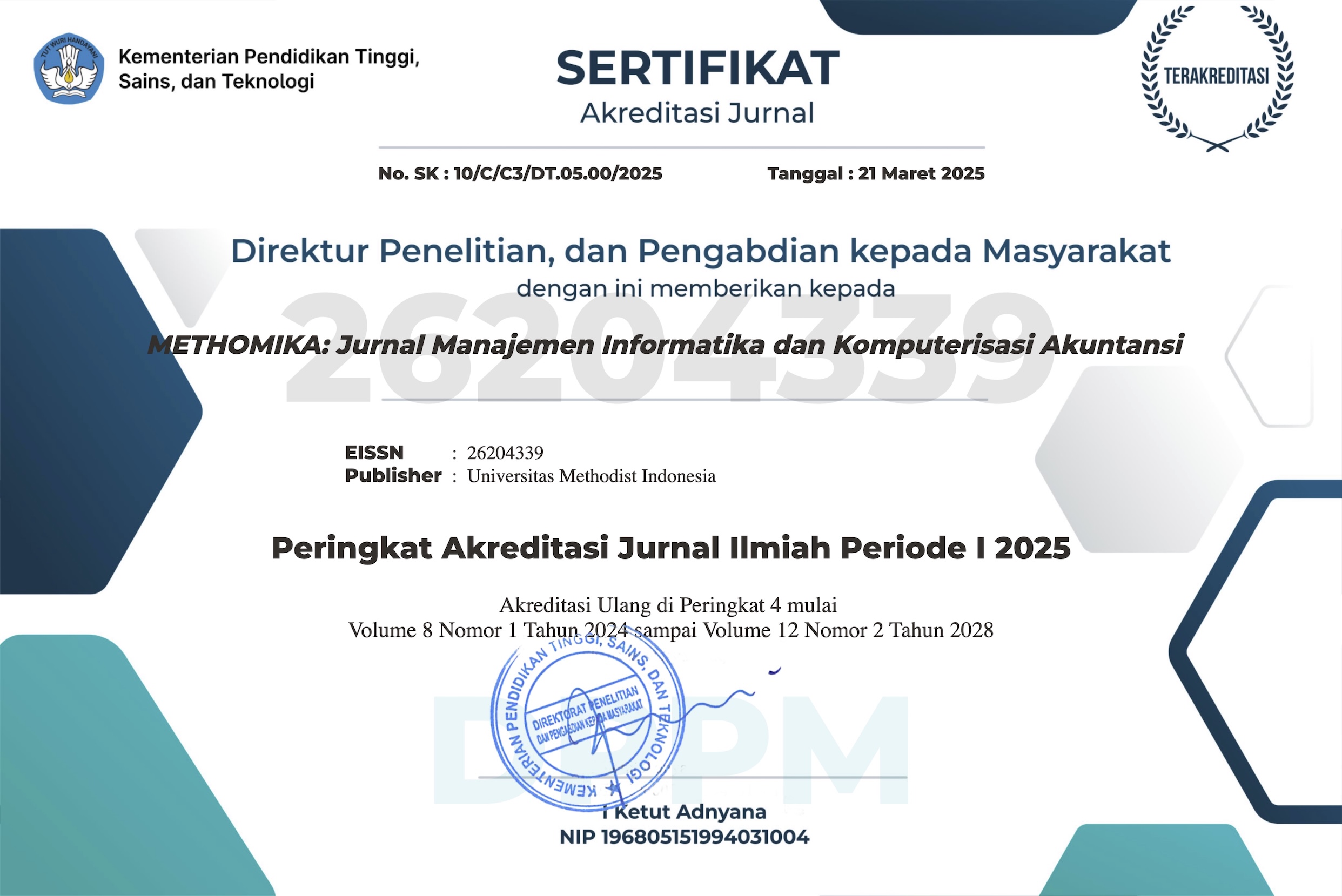
Sertifikat Akreditasi

METHOMIKA | PUBLICATION POLICY
Promoting transparency, accountability, and integrity in scholarly authorship.
METHOMIKA: Jurnal Manajemen Informatika & Komputerisasi Akuntansi is committed to ensuring transparency, fairness, accountability, and academic integrity in the authorship of all submitted and published manuscripts.
Authorship must reflect genuine intellectual contributions to the research and preparation of scholarly manuscripts. This policy is informed by the recommendations of the International Committee of Medical Journal Editors (ICMJE), the publication ethics principles of the Committee on Publication Ethics (COPE), and the Contributor Roles Taxonomy (CRediT).
Individuals must meet all four of the following criteria to qualify for authorship:
Making substantial contributions to the conception or design of the study, or the acquisition, analysis, or interpretation of research data.
Drafting the manuscript or critically reviewing it for important intellectual content.
Reviewing and approving the final version of the manuscript intended for publication.
Agreeing to be accountable for all aspects of the work and ensuring that questions concerning its accuracy or integrity are appropriately investigated and resolved.
All individuals who meet these four criteria must be identified as authors. Individuals who do not meet all four criteria should be acknowledged appropriately rather than listed as authors.
All authors are expected to provide a clear statement describing their individual contributions to the research and manuscript preparation. METHOMIKA encourages the use of the Contributor Roles Taxonomy (CRediT).
Multiple authors may share the same contribution role, and an author may perform multiple roles. Assignment of a CRediT role does not automatically establish eligibility for authorship.
The corresponding author serves as the primary contact between the authors and the editorial office throughout the submission, peer review, publication, and post-publication processes.
The order of authors must be determined by mutual agreement among all authors, based on their respective contributions to the research and manuscript preparation. Authorship order should not be determined solely by academic position, administrative authority, seniority, or institutional relationships.
Individuals who contribute to the research but do not satisfy all authorship criteria may be recognized in the Acknowledgments section, with their permission.
Activities that do not independently qualify an individual for authorship include:
Any proposed addition, removal, or rearrangement of authors after manuscript submission must be formally communicated to the editorial office. The corresponding author must provide:
The editorial team will evaluate authorship change requests based on the available documentation and applicable publication ethics principles. Changes after publication may require a formal correction.
METHOMIKA does not accept unethical authorship practices, including:
Suspected unethical authorship practices may be subject to editorial assessment and, when appropriate, institutional investigation.
Artificial intelligence tools, including generative AI systems, large language models, and chatbots, cannot be listed as authors or co-authors because they cannot assume responsibility or accountability for scholarly work.
Authors must disclose the use of AI-assisted technologies in manuscript preparation or research. Such disclosures should identify the tools used and explain their purposes. AI-assisted writing should be disclosed in the Acknowledgments section, while AI-assisted research methods, data analysis, or figure generation should be described in the relevant methodology section.
Human authors remain fully responsible for the accuracy, originality, integrity, citations, and content of submitted and published manuscripts.
Disagreements regarding authorship eligibility, author order, or individual contributions should initially be resolved through discussion among the authors. If no agreement can be reached, the editorial team may request supporting documentation and refer the matter to the relevant research institution.
Editorial processing may be suspended until serious authorship disputes have been appropriately resolved.
Effective from Volume 11, Number 1 (April 2027), manuscripts intended for publication in METHOMIKA must be written entirely in English. Editorial correspondence, peer review comments, author responses, and scholarly discussions must also be conducted in English.
International Committee of Medical Journal Editors (ICMJE). Defining the Role of Authors and Contributors.
Committee on Publication Ethics (COPE). Publication Ethics Guidelines and Resources.
Contributor Roles Taxonomy (CRediT). Contributor Roles Taxonomy.
METHOMIKA: Jurnal Manajemen Informatika & Komputerisasi Akuntansi
Published by Universitas Methodist Indonesia
Website: https://ejurnal.methodist.ac.id/index.php/methomika/
AKREDITASI
Sertifikat Akreditasi

METHOMIKA: Jurnal Manajemen Informatika & Komputerisasi Akuntansi
is licensed under a Creative Commons Attribution-NonCommercial 4.0 International License (CC BY-NC 4.0)