AKREDITASI
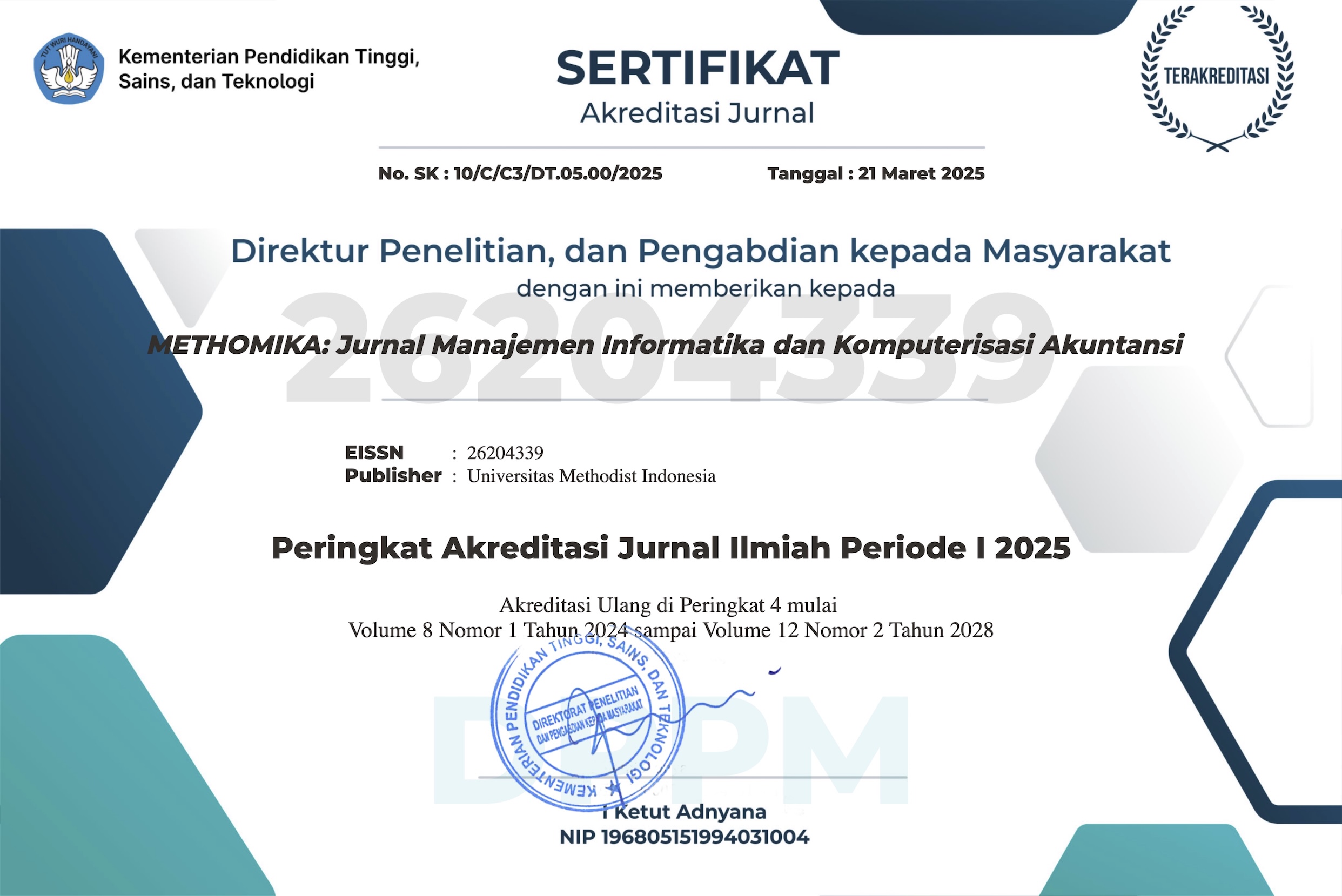
Sertifikat Akreditasi

METHOMIKA | AUTHOR INFORMATION
Guidelines for scholarly contributions and manuscript preparation.
METHOMIKA: Jurnal Manajemen Informatika & Komputerisasi Akuntansi is a peer-reviewed, open-access scientific journal that provides a platform for disseminating scholarly contributions in Informatics Management, Information Systems, Computer Science, Information Technology, and Computerized Accounting.
Manuscripts should demonstrate scientific originality, methodological rigor, analytical depth, and relevance to the journal's Focus and Scope. The following manuscript categories describe the forms of scholarly contributions considered under the journal's proposed editorial framework.
Original Research Articles present new scientific findings derived from systematic investigations, experiments, computational modeling, empirical analysis, or the development and evaluation of information technology solutions.
Examples of eligible research:
Recommended manuscript structure:
Title, Abstract, Keywords, Introduction, Literature Review (if applicable), Research Methods, Results and Discussion, Conclusion, Acknowledgments (if applicable), and References.
Review Articles provide a comprehensive, structured, and critical synthesis of previously published research within the journal's academic scope. Such manuscripts should identify significant developments, methodological trends, research limitations, knowledge gaps, and opportunities for future investigation.
Examples of review approaches:
Review Articles should clearly describe their search strategy, data sources, eligibility criteria, study selection procedures, and methods of synthesis. Systematic reviews should follow relevant reporting guidelines, such as PRISMA, where applicable.
Recommended manuscript structure:
Introduction, Review Methodology, Results, Critical Discussion, Research Gaps and Future Directions, Conclusion, and References.
Short Communications present concise and focused research findings that offer a clear scientific or technological contribution. These manuscripts may report preliminary findings, innovative computational approaches, experimental observations, or targeted evaluations of new technologies.
Expected characteristics:
Recommended manuscript structure:
Introduction, Methods, Results and Discussion, Conclusion, and References.
Originality: Manuscripts must contain original scholarly work and must not have been published previously or be under consideration by another journal.
Language: English is required for manuscripts intended for publication beginning with Volume 11, Number 1 (2027).
File Format: Microsoft Word (.docx), following the official METHOMIKA manuscript template.
Manuscript Length: 4-15 pages, in accordance with the journal's current author guidelines, unless an approved category-specific requirement provides otherwise.
References: APA referencing style, with citations and reference metadata managed using appropriate reference software.
Similarity: Manuscripts must comply with the journal's similarity threshold of less than 20%. The editorial team may also assess the context and significance of detected similarities.
Research Ethics: All submissions must comply with the journal's authorship, research integrity, plagiarism, and publication ethics policies.
All manuscripts are subject to an initial editorial screening to assess their relevance to the journal's Focus and Scope, originality, academic quality, methodological adequacy, language quality, and compliance with submission requirements.
The editorial team may request revisions, recommend reclassification of a manuscript, or decline submissions that do not meet the journal's requirements. Manuscripts passing the initial assessment may proceed to peer review. Acceptance is not guaranteed by successful completion of the initial screening.
As a proposed editorial policy, the following submissions are not considered suitable:
Effective from Volume 11, Number 1 (April 2027), manuscripts intended for publication in METHOMIKA must be prepared entirely in English. This requirement also applies to editorial correspondence, reviewer comments, author responses, manuscript revisions, and scholarly discussions throughout the publication process.
METHOMIKA: Jurnal Manajemen Informatika & Komputerisasi Akuntansi
Published by Universitas Methodist Indonesia
Publication Frequency: April and October
AKREDITASI
Sertifikat Akreditasi

METHOMIKA: Jurnal Manajemen Informatika & Komputerisasi Akuntansi
is licensed under a Creative Commons Attribution-NonCommercial 4.0 International License (CC BY-NC 4.0)