AKREDITASI
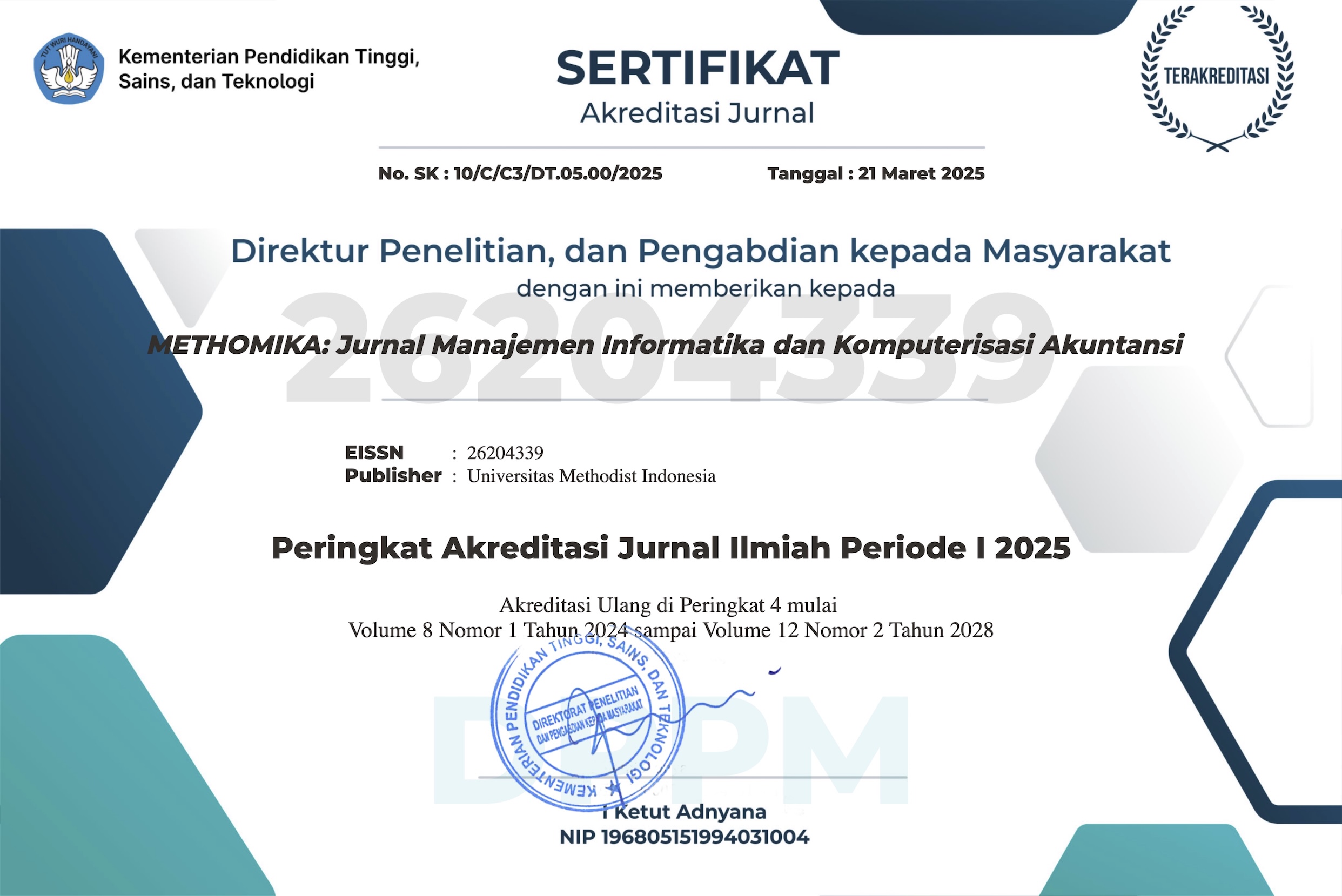
Sertifikat Akreditasi

METHOMIKA | AUTHOR INFORMATION
Instructions for manuscript preparation, submission, peer review, and publication.
METHOMIKA: Jurnal Manajemen Informatika & Komputerisasi Akuntansi is a peer-reviewed, open-access scientific journal published by Universitas Methodist Indonesia. The journal publishes original scholarly contributions in Informatics Management, Information Systems, Computer Science, Information Technology, and Computerized Accounting.
Authors are required to carefully follow these guidelines before submitting their manuscripts. Submissions that do not comply with the journal's requirements may be returned for correction or declined during the initial editorial assessment.
| Manuscript Language | English (from Vol. 11 No. 1, 2027) |
| File Format | Microsoft Word (.docx) |
| Manuscript Length | 4-15 pages |
| Reference Style | APA Style |
| Reference Manager | Mendeley |
| Similarity Threshold | Below 20% |
| Scheduled Review Period | 2-4 weeks |
Authors submitting manuscripts to METHOMIKA must comply with the following requirements:
Effective from Volume 11, Number 1 (April 2027), all manuscripts intended for publication in METHOMIKA must be written entirely in English.
The English language requirement applies to:
Manuscripts must demonstrate clear, accurate, grammatically correct, and appropriate academic English. Authors are responsible for the linguistic quality of their submitted work.
Authors must prepare their manuscripts using the official METHOMIKA manuscript template.
The official manuscript template is available through the journal's submission guidelines.
Original Research Articles should generally contain the following components:
The title should be concise, informative, and representative of the research objectives, methods, or principal contribution. Avoid unnecessary abbreviations and overly broad expressions.
Provide the full names of all authors, institutional affiliations, and corresponding author information. Ensure consistency between the manuscript and OJS metadata. ORCID identifiers should be provided where available.
The abstract should summarize the research background or problem, objectives, methodology, key findings, and principal conclusions. It should be presented as a single coherent paragraph in English and follow the word limit specified in the official manuscript template.
Provide relevant keywords in English that accurately represent the main concepts, research methods, and subject matter of the manuscript. Follow the number and formatting rules in the official template.
The Introduction should explain the research background, problem statement, significance, relevant previous studies, research gap, objectives, and expected scientific contributions. The novelty and motivation of the study should be clearly identified.
This section provides relevant theoretical foundations and empirical evidence. It should critically synthesize previous research rather than merely list existing studies. Research hypotheses may be developed where appropriate.
Describe the research design, data sources, study objects, instruments, procedures, algorithms or models, experimental settings, evaluation metrics, and analytical methods. Provide sufficient information to support reproducibility and methodological assessment.
Present research results systematically using appropriate tables, figures, quantitative measurements, or qualitative evidence. Interpret the findings critically, compare them with relevant previous studies, explain their scientific or practical implications, and acknowledge important limitations.
Summarize the principal findings and explain how the research objectives have been addressed. Highlight significant contributions and, where relevant, limitations and recommendations for future research. Avoid introducing unsupported claims or new results.
Where applicable, acknowledge research funding, institutional support, and contributors who do not qualify for authorship. Authors should disclose relevant conflicts of interest, research ethics information, and the use of AI-assisted tools in accordance with journal policies.
All sources cited in the manuscript must appear in the reference list, and all entries in the reference list must be cited in the manuscript. References must follow APA Style and be managed using Mendeley as required by the journal.
Tables, figures, and equations must be relevant, clearly presented, and discussed in the manuscript.
METHOMIKA requires authors to use APA referencing style and the Mendeley reference management application.
Authors must ensure that their manuscripts have a similarity score below 20% before proceeding to peer review. The editorial team may examine the similarity report to assess the originality of the manuscript, the accuracy of citations, and potential publication ethics violations.
A low similarity percentage does not automatically establish originality or guarantee acceptance. Plagiarism, inappropriate paraphrasing, duplicate publication, and misrepresentation of research findings are not acceptable.
Manuscripts must be submitted electronically through the METHOMIKA Open Journal Systems (OJS) platform.
All submissions undergo an initial editorial assessment before being considered for peer review. The screening may include manuscript completeness, relevance to the journal's scope, similarity, methodological adequacy, language quality, and compliance with editorial requirements.
Manuscripts meeting the initial requirements may proceed to the journal's peer review process. The review process is scheduled for approximately 2-4 weeks, subject to the availability of reviewers and the complexity of the manuscript.
Authors are expected to respond promptly and constructively to reviewer recommendations. Revised manuscripts should be accompanied by a clear response explaining the changes made or providing academic justification for recommendations not adopted.
Editorial decisions are based on scientific quality, methodological rigor, originality, relevance, reviewer evaluations, and compliance with journal policies.
Authors may receive decisions requesting revisions, accepting the manuscript, or declining publication. An official Letter of Acceptance (LoA) will be issued only after the manuscript has been formally accepted following the editorial and peer review process.
Publication scheduling is determined by the editorial team, taking into account completed reviews, final acceptance, manuscript readiness, and the journal's publication plan.
Authors are responsible for maintaining academic honesty, transparency, and research integrity.
Authors retain copyright in their published articles and acknowledge METHOMIKA as the original place of publication. Articles are published under the Creative Commons Attribution-NonCommercial 4.0 International (CC BY-NC 4.0) license.
Authors may share and distribute their published work in accordance with the license terms, provided that appropriate attribution and acknowledgment of the original publication are maintained.
Before completing a submission, authors should verify that:
METHOMIKA: Jurnal Manajemen Informatika & Komputerisasi Akuntansi
Published by Universitas Methodist Indonesia
Publication Frequency: April and October
Website: ejurnal.methodist.ac.id/index.php/methomika/
AKREDITASI
Sertifikat Akreditasi

METHOMIKA: Jurnal Manajemen Informatika & Komputerisasi Akuntansi
is licensed under a Creative Commons Attribution-NonCommercial 4.0 International License (CC BY-NC 4.0)