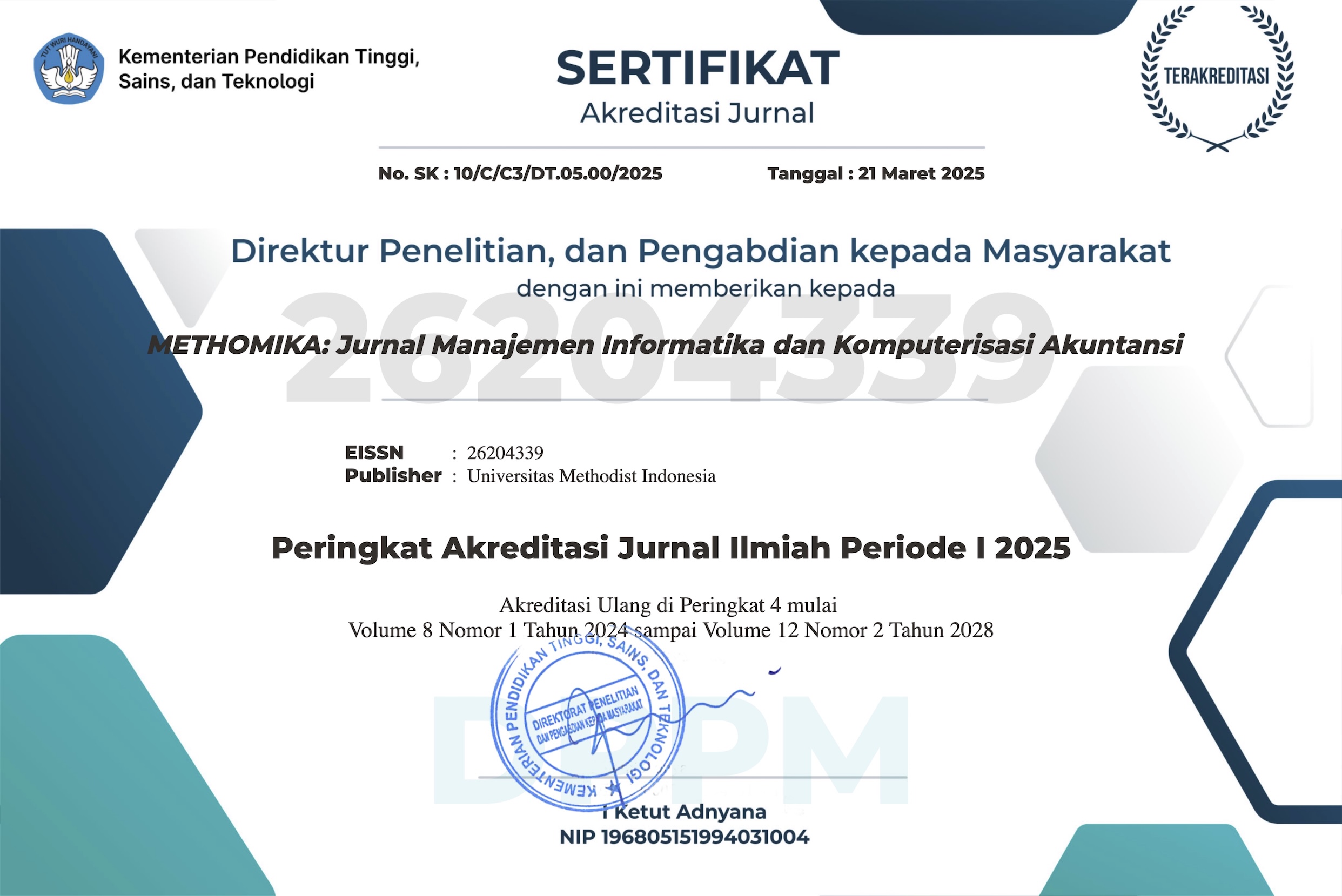
AKREDITASI
Sertifikat Akreditasi

METHOMIKA | EDITORIAL POLICY
Safeguarding impartiality, transparency, and integrity in scholarly publishing.
METHOMIKA: Jurnal Manajemen Informatika & Komputerisasi Akuntansi, published by Universitas Methodist Indonesia, is committed to maintaining objectivity, transparency, independence, accountability, and integrity throughout the scholarly publication process.
All individuals involved in manuscript preparation, submission, peer review, editorial decision-making, and publication must disclose any relationships or interests that could influence, or reasonably be perceived to influence, their professional judgments and responsibilities.
This policy is informed by the publication ethics principles of the Committee on Publication Ethics (COPE) and the recommendations of the International Committee of Medical Journal Editors (ICMJE).
A conflict of interest, also referred to as a competing interest, arises when an individual's financial, personal, professional, academic, or institutional relationships could influence, or appear to influence, the objectivity of research, manuscript evaluation, or editorial decisions.
A conflict of interest does not necessarily indicate misconduct or invalidate research. However, relevant relationships and interests must be disclosed transparently so that potential bias can be appropriately evaluated and managed.
Research funding, employment, consultancy, honoraria, stock ownership, patents, licensing income, or other financial relationships relevant to the research.
Family relationships, close friendships, personal disputes, or other relationships that could compromise impartiality.
Recent research collaborations, supervisory relationships, academic competition, or professional rivalries that could affect independent judgment.
Institutional affiliations, administrative responsibilities, organizational commitments, or institutional interests that could influence research or publication decisions.
Strong intellectual commitments, competing research interests, or other circumstances that may reasonably affect independent academic assessment.
All authors must disclose relevant financial and nonfinancial interests that could influence the design, implementation, analysis, interpretation, or reporting of their research.
Authors should disclose, where applicable:
Disclosure should be made at manuscript submission and updated if relevant circumstances change during the editorial and publication process.
The corresponding author is responsible for coordinating conflict of interest declarations from all co-authors and communicating them to the editorial office.
Editors and editorial board members must maintain independence and impartiality in the evaluation and selection of manuscripts.
Manuscripts submitted by editors or editorial board members should be managed by an independent editor who has no relevant conflict of interest. The submitting editor must not influence reviewer selection or the editorial decision.
Reviewers must disclose any relationships or interests that could affect their ability to provide an objective, independent, and constructive evaluation.
Potential conflicts may include:
Reviewers should decline or withdraw from an assignment when a conflict prevents an impartial assessment. If uncertain, reviewers must consult the handling editor before accepting or continuing the review.
Reviewers must not use unpublished manuscripts or confidential research information for personal, academic, financial, or competitive advantage.
The publisher, journal management, sponsors, and other supporting organizations must respect the independence of the editorial decision-making process.
Financial contributions, publication fees, institutional relationships, or administrative interests must not determine manuscript acceptance, reviewer recommendations, or editorial decisions.
Potential conflicts of interest should be identified and managed through a transparent editorial procedure.
Authors, reviewers, editors, and other participants identify relationships and interests relevant to their roles.
Relevant interests are disclosed in writing through OJS or official editorial communication channels.
The handling editor evaluates the nature and significance of the reported interests. Conflicts involving the handling editor are assessed by an independent editorial representative.
Actions may include additional disclosure, reassignment of an editor or reviewer, recusal from an editorial decision, or other appropriate safeguards.
Relevant declarations and management decisions should be documented in the editorial records while respecting confidentiality and data protection requirements.
When an undisclosed or inadequately managed conflict of interest is identified after publication, the editorial team should evaluate the available evidence and request explanations from the parties concerned.
Depending on the nature and seriousness of the concern, appropriate action may include:
Each manuscript should include a Conflict of Interest declaration. Authors must provide an accurate statement based on their individual disclosures.
The authors declare that they have no financial or nonfinancial conflicts of interest relevant to this study.
The authors disclose the following competing interests relevant to this research: [describe the relationship or interest]. The role of the relevant organization in the research and publication process is described as follows: [provide details].
These examples are illustrative. Each declaration must accurately reflect the authors' circumstances. Funding acknowledgments should be reported separately where required by the journal template.
Failure to disclose a relevant relationship or interest may compromise the transparency of the editorial process.
Suspected deliberate concealment or misleading declarations may be assessed in accordance with the journal's Publication Ethics Policy and applicable COPE guidance. Editorial action should be based on documented evidence and proportional to the concern.
Conflict of interest disclosures submitted during the editorial process must be handled responsibly. Confidential details should only be shared with authorized personnel when necessary for appropriate assessment and management. Public declarations should provide relevant transparency without unnecessarily disclosing unrelated personal information.
Effective from Volume 11, Number 1 (April 2027), all manuscripts intended for publication in METHOMIKA must be written entirely in English. Conflict of Interest declarations, editorial correspondence, reviewer reports, author responses, and scholarly discussions throughout the publication process must also be conducted in English.
Committee on Publication Ethics (COPE). Publication Ethics Resources.
COPE. Ethical Guidelines for Peer Reviewers.
International Committee of Medical Journal Editors (ICMJE). Disclosure of Financial and Non-Financial Relationships and Activities.
METHOMIKA: Jurnal Manajemen Informatika & Komputerisasi Akuntansi
Published by Universitas Methodist Indonesia
Publication Frequency: April and October
Official Journal Website
AKREDITASI
Sertifikat Akreditasi

METHOMIKA: Jurnal Manajemen Informatika & Komputerisasi Akuntansi
is licensed under a Creative Commons Attribution-NonCommercial 4.0 International License (CC BY-NC 4.0)