AKREDITASI
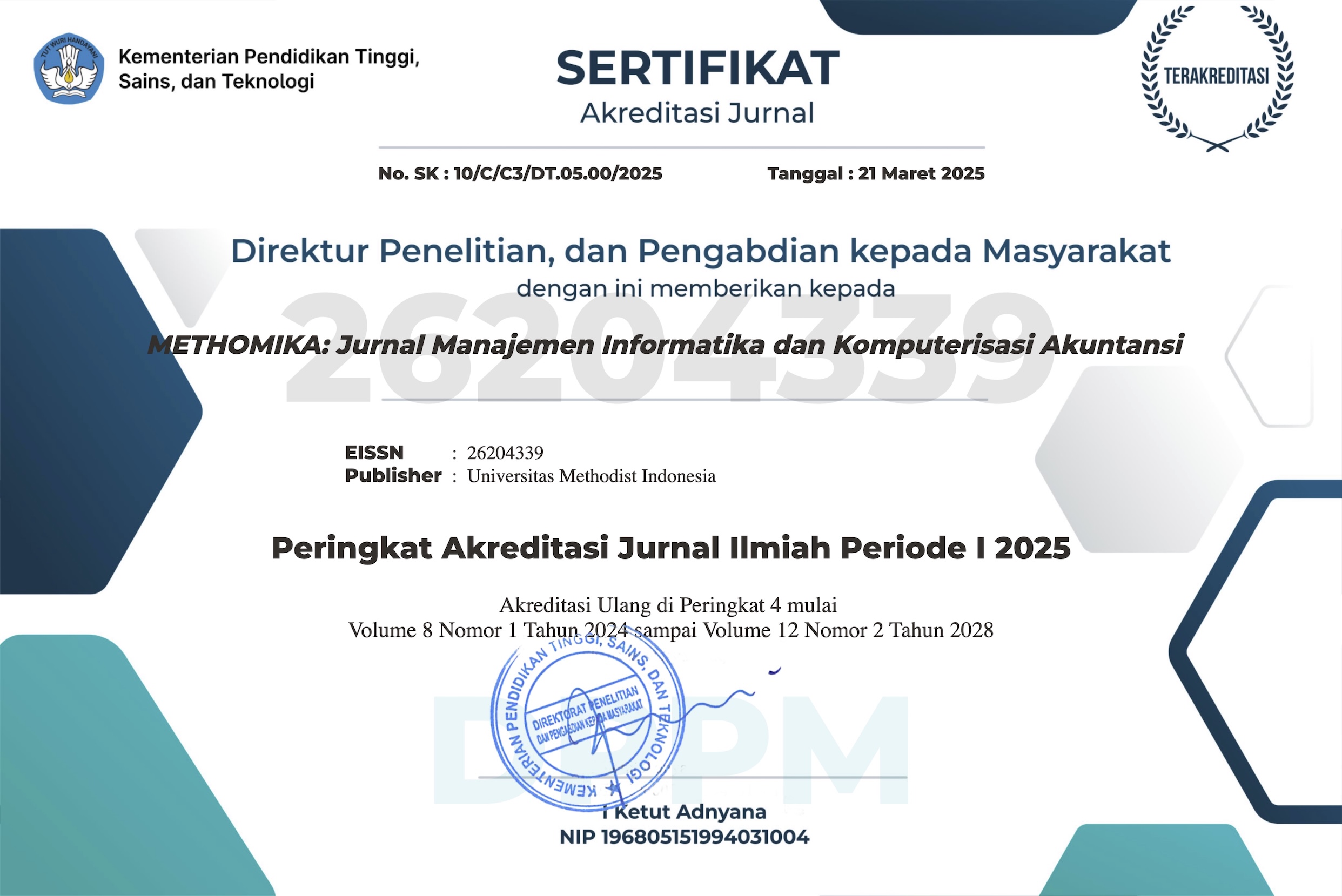
Sertifikat Akreditasi

METHOMIKA | EDITORIAL POLICY
Maintaining the accuracy, transparency, reliability, and integrity of the scholarly record.
METHOMIKA: Jurnal Manajemen Informatika & Komputerisasi Akuntansi, published by Universitas Methodist Indonesia, is committed to preserving the accuracy, reliability, transparency, and integrity of the scholarly record.
Errors, inaccuracies, or concerns regarding research integrity may be identified after an article has been published. The journal recognizes its responsibility to address such concerns through appropriate post-publication editorial actions.
This policy establishes procedures for corrections, expressions of concern, retractions, and exceptional content removal. It is informed by the principles of the Committee on Publication Ethics (COPE), including its Retraction Guidelines updated in August 2025.
| Editorial Action | Purpose |
|---|---|
| Correction | Correct significant errors while the principal research conclusions remain reliable. |
| Expression of Concern | Inform readers about serious unresolved questions concerning an article. |
| Retraction | Alert readers when an article is unreliable or meets other grounds for retraction. |
| Exceptional Content Removal | Restrict or remove content only when compelling legal, privacy, or safety circumstances require such action. |
METHOMIKA applies the following principles when evaluating concerns about published articles:
A correction may be published when a significant error is identified in an article but the error does not fundamentally undermine the reliability of the research findings and principal conclusions.
Examples of errors requiring correction include:
The editorial team evaluates the error and determines whether a formal correction notice is necessary. Minor typographical changes that do not affect scholarly interpretation may be handled editorially, with changes documented when appropriate.
An Expression of Concern may be published when serious questions arise concerning the reliability or integrity of a published article but the available evidence is insufficient to reach a final decision.
Circumstances may include:
An Expression of Concern does not automatically establish that research misconduct occurred. Its purpose is to inform readers about significant unresolved concerns.
Once relevant information becomes available, the editorial team may update or withdraw the notice, issue a correction, retract the article, or conclude that no further editorial action is necessary.
Retraction is considered when reliable evidence demonstrates that an article contains serious flaws or integrity problems that make its principal findings or conclusions unreliable, or when other substantial publication ethics violations justify retraction.
Retraction is intended to correct the scholarly record and protect readers from unreliable information. It is not intended as punishment for authors.
Grounds for retraction may include:
Authors, readers, reviewers, editors, or other parties may report potential errors or integrity concerns through the journal's official channels.
The editorial team examines the reported concern and the available documentation to determine its relevance and potential impact.
Editorial personnel with relevant conflicts must not determine the outcome. An independent editor should be assigned where necessary.
Authors are given an appropriate opportunity to respond and provide relevant explanations or supporting evidence, unless exceptional circumstances make this impracticable.
Editors may review research data, published literature, correspondence, expert opinions, or institutional findings as appropriate.
The responsible editor determines whether a correction, expression of concern, retraction, or another response is warranted.
Any formal action is documented and communicated transparently through the journal's publication platform and relevant metadata.
When a correction is required, the journal should publish an accessible notice that clearly identifies the affected article.
A correction notice should include:
The correction notice should be linked to the original article. If the article file is updated, the change should be identified transparently rather than silently replacing substantive published content.
When an article is retracted, METHOMIKA should publish a clearly identified and freely accessible Retraction Notice.
The notice should contain:
Retraction notices must avoid misleading language, unsupported allegations, or inappropriate personal accusations. The article and notice should be linked in both directions.
The original article should be prominently labelled as RETRACTED on its landing page and in its downloadable files where technically feasible.
Retracted articles should generally remain accessible in the journal's archives as part of the permanent scholarly record.
The editorial team should ensure that:
Retraction does not normally require deleting the article from the archive. Retaining a clearly marked record helps prevent confusion and preserves the history of scholarly communication.
Removal or restriction of published content is an exceptional action distinct from retraction.
Such action may be considered when compelling circumstances exist, including:
Where feasible and legally permissible, a bibliographic record and an explanatory notice should remain accessible to preserve the traceability of the publication.
Authors are expected to:
The responsible editor has the authority to determine appropriate post-publication editorial action in accordance with the journal's policies and available evidence.
When a case involves research conduct beyond the journal's investigative authority, the editorial team may communicate relevant concerns to the appropriate research institution.
Institutional investigations and editorial actions serve different purposes. The journal may need to act to protect readers even when an institutional process is ongoing. Editors with relevant conflicts of interest must recuse themselves from the decision.
Corrections, expressions of concern, and retractions should be reflected in the article's online publication information and metadata, as appropriate.
Where technically supported, the journal should:
Authors and other affected parties may submit reasoned appeals concerning correction or retraction decisions through the journal's official communication channels.
Appeals should provide relevant evidence or identify material procedural concerns. An appropriate editor without a relevant conflict of interest should review the appeal. An appeal does not automatically suspend necessary measures to protect the scholarly record.
Requests for corrections, allegations concerning published articles, and related post-publication inquiries may be submitted to the METHOMIKA editorial office through the journal's official contact channels.
Effective from Volume 11, Number 1 (April 2027), manuscripts intended for publication in METHOMIKA must be written entirely in English. Editorial correspondence, reviewer reports, author responses, and scholarly discussions throughout the publication process must also be conducted in English. Post-publication notices should be published in English, while relevant evidence may be reviewed in its original language when necessary.
Committee on Publication Ethics (COPE). Retraction Guidelines (Updated August 2025).
International Committee of Medical Journal Editors (ICMJE). Recommendations for the Conduct, Reporting, Editing, and Publication of Scholarly Work.
METHOMIKA. Publication Ethics Policy.
METHOMIKA: Jurnal Manajemen Informatika & Komputerisasi Akuntansi
Published by Universitas Methodist Indonesia
Publication Frequency: April and October
Official Journal Website
AKREDITASI
Sertifikat Akreditasi

METHOMIKA: Jurnal Manajemen Informatika & Komputerisasi Akuntansi
is licensed under a Creative Commons Attribution-NonCommercial 4.0 International License (CC BY-NC 4.0)