AKREDITASI
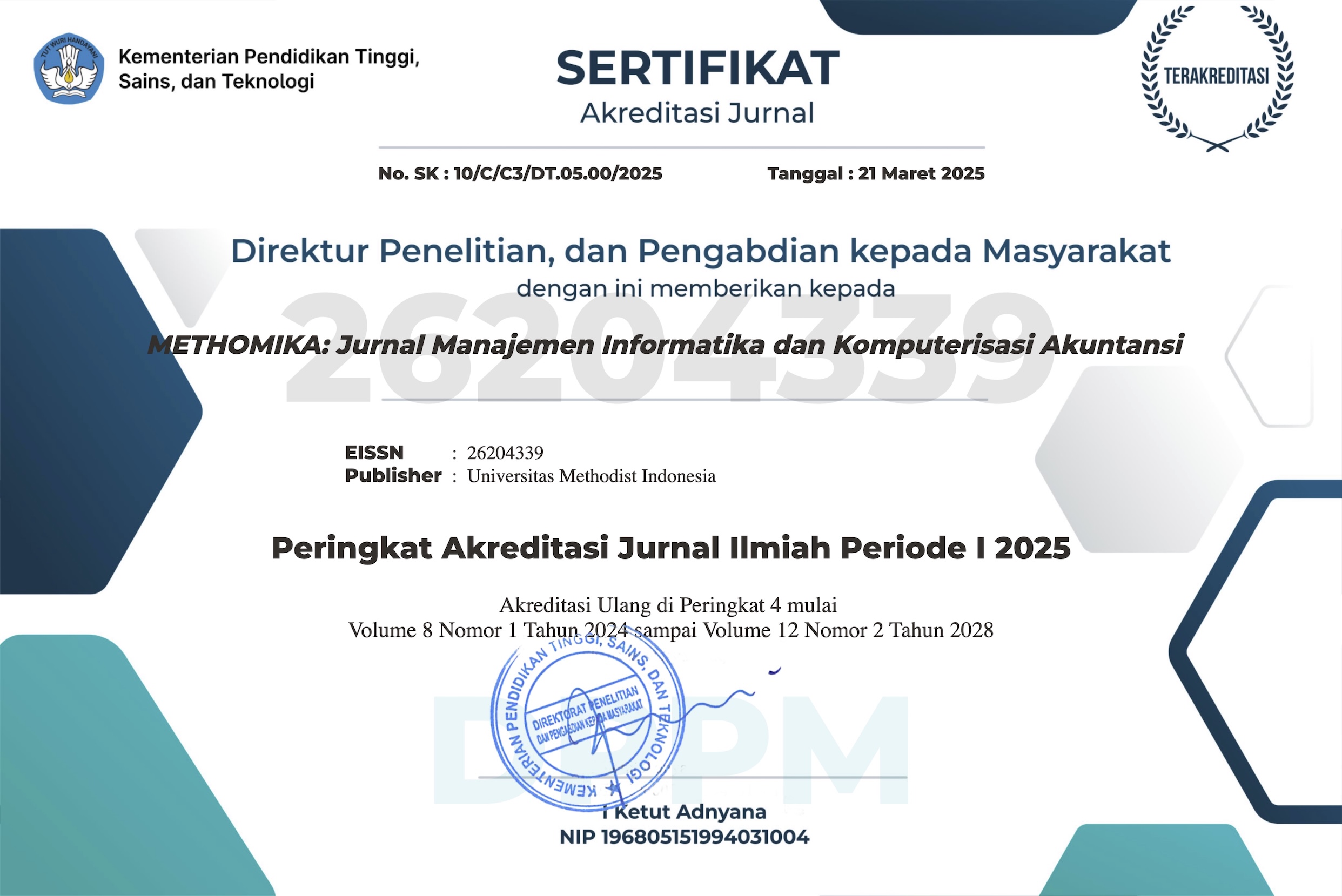
Sertifikat Akreditasi

METHOMIKA | EDITORIAL POLICY
Upholding research integrity, ethical responsibility, and transparency in scholarly publishing.
METHOMIKA: Jurnal Manajemen Informatika & Komputerisasi Akuntansi is a peer-reviewed scientific journal published by Universitas Methodist Indonesia. The journal is committed to maintaining high standards of academic integrity, transparency, accountability, and ethical conduct throughout the scholarly publication process.
This Publication Ethics Policy outlines the ethical responsibilities of the publisher, journal management, editors, reviewers, authors, and other parties involved in manuscript evaluation and publication.
The policy is informed by the principles and best practices established by the Committee on Publication Ethics (COPE) and aims to safeguard the integrity of published scientific research.
METHOMIKA upholds three fundamental ethical principles in scholarly publishing:
Editorial and publication decisions must remain independent of inappropriate personal, institutional, financial, or other competing interests.
All submissions must be evaluated fairly based on scientific merit, originality, methodological quality, and relevance, without discrimination.
Scholarly work must be free from plagiarism, fabrication, falsification, duplicate publication, misleading claims, and deliberate misrepresentation of research findings.
Universitas Methodist Indonesia, as the publisher, and the journal management are responsible for supporting ethical, sustainable, and transparent scholarly publishing.
Editors are responsible for managing the editorial process fairly and maintaining the scientific quality and integrity of published articles.
Editors must not use unpublished research material or confidential information obtained during editorial handling for personal research or professional advantage.
Reviewers play an essential role in maintaining scholarly quality by providing independent, objective, and constructive evaluations.
Reviewers must not disclose manuscript content to unauthorized third parties or upload confidential submissions to external AI systems without explicit editorial authorization and appropriate confidentiality safeguards.
Authors are responsible for ensuring that their submitted manuscripts represent original, accurate, and ethically conducted research.
METHOMIKA does not tolerate research and publication misconduct, including:
Allegations of misconduct may be reported to the editorial office before or after publication. Reports should provide sufficient information to allow a reasonable preliminary assessment. The editorial team will handle allegations fairly, confidentially, and without prejudging the individuals involved.
The proposed procedure includes:
Depending on the findings, editorial actions may include manuscript rejection, additional review, correction, expression of concern, retraction, or referral to the relevant research institution.
Authorship must reflect genuine intellectual contributions to the research. All authors must meet the journal's Authorship Criteria and approve the submitted and final versions of their work. Individuals who contribute without qualifying for authorship should be acknowledged appropriately. Changes to authorship must be documented and approved through established editorial procedures.
Authors, reviewers, and editors must disclose financial, professional, personal, institutional, or other relationships that could reasonably influence the research or editorial process.
Editors and reviewers with significant competing interests should withdraw from handling affected manuscripts. The editorial team may request additional disclosures or assign independent personnel when appropriate.
Research involving human participants, personal data, confidential organizational information, or other ethically sensitive materials must comply with applicable laws, institutional requirements, and relevant research ethics standards.
Artificial intelligence tools, including generative AI systems and large language models, cannot be recognized as authors because they cannot accept accountability for research accuracy, integrity, and scholarly content.
Authors must disclose substantive use of AI-assisted technologies in research, manuscript preparation, data analysis, or image generation, indicating the tools used and their purposes.
Authors remain responsible for verifying all AI-assisted content, including citations, data, results, and interpretations. The use of AI must not facilitate plagiarism, fabrication, falsification, or misleading representation of research findings.
METHOMIKA recognizes the importance of preserving an accurate and trustworthy scholarly record. When significant errors or ethical concerns are identified after publication, the editorial team may take appropriate action.
Published notices should clearly identify the affected article, explain the reason for the editorial action, and remain accessible to readers. Retractions are intended to correct the scholarly record, not to punish authors.
Authors, reviewers, readers, and other stakeholders may submit concerns regarding editorial decisions, publication procedures, or possible ethical violations through the journal's official communication channels.
Complaints and appeals should include a clear explanation and relevant supporting evidence. The editorial team will evaluate such matters fairly and, where appropriate, seek independent advice or institutional assistance. Appeals do not automatically result in reversal of previous editorial decisions.
METHOMIKA encourages responsible scholarly discussion of published research. Readers and researchers may communicate substantive questions, comments, or concerns to the editorial office. Where appropriate, authors may be invited to respond, and the editorial team may consider publishing clarifications, corrections, or other relevant notices.
Effective from Volume 11, Number 1 (April 2027), manuscripts intended for publication in METHOMIKA must be written entirely in English. Editorial correspondence, reviewer reports, author responses, revisions, and scholarly discussions throughout the publication process must also be conducted in English.
Committee on Publication Ethics (COPE). Core Practices.
Committee on Publication Ethics (COPE). Principles of Transparency and Best Practice in Scholarly Publishing.
Committee on Publication Ethics (COPE). Retraction Guidelines.
METHOMIKA: Jurnal Manajemen Informatika & Komputerisasi Akuntansi
Published by Universitas Methodist Indonesia
Publication Frequency: April and October
Official Journal Website
AKREDITASI
Sertifikat Akreditasi

METHOMIKA: Jurnal Manajemen Informatika & Komputerisasi Akuntansi
is licensed under a Creative Commons Attribution-NonCommercial 4.0 International License (CC BY-NC 4.0)