AKREDITASI
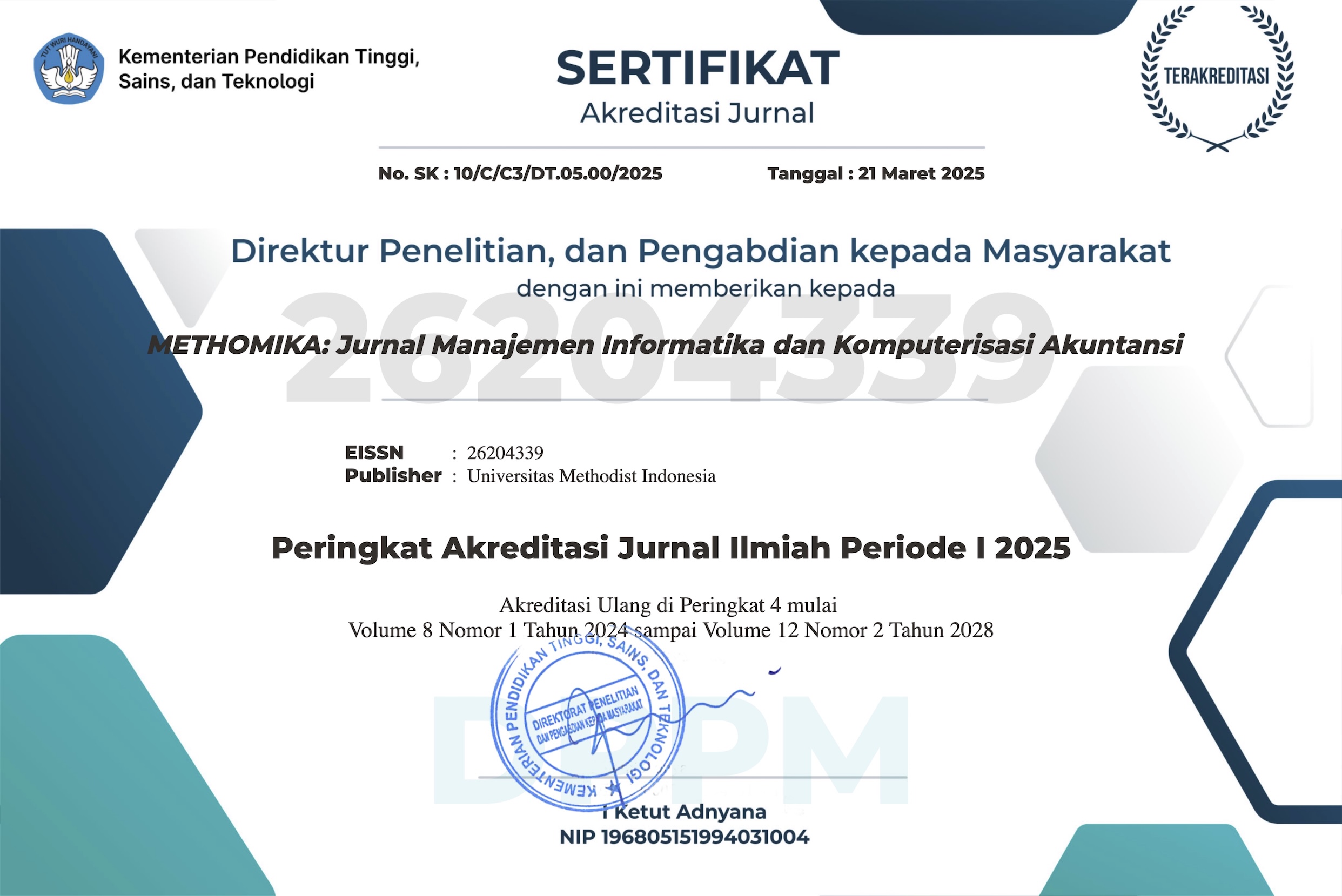
Sertifikat Akreditasi

METHOMIKA | EDITORIAL POLICY
Encouraging constructive scholarly dialogue, transparency, and continuous research evaluation.
METHOMIKA: Jurnal Manajemen Informatika & Komputerisasi Akuntansi, published by Universitas Methodist Indonesia, is committed to supporting open, transparent, constructive, and responsible scholarly communication after publication.
Publication does not mark the end of scientific evaluation. Published research remains open to academic discussion, critical examination, alternative interpretations, clarification, and further scholarly investigation.
This policy is informed by the Committee on Publication Ethics (COPE) Core Practices, particularly those concerning post-publication discussions, corrections, and the integrity of the scholarly record.
Post-publication discussion aims to:
METHOMIKA welcomes relevant, constructive, and evidence-based discussion concerning published scholarly articles, including:
Questions concerning research design, data collection procedures, analytical techniques, experimental validity, and methodological limitations.
Scientific criticism, alternative interpretations, and discussion of the validity or significance of reported findings.
Requests for clarification concerning datasets, computational procedures, reproducibility, and the interpretation of research evidence.
Discussion of theoretical foundations, research implications, scientific contributions, and practical applications of published studies.
Identification of significant citation inaccuracies, missing attributions, or relevant literature requiring clarification.
Substantiated concerns involving research ethics, reporting accuracy, data integrity, plagiarism, or other publication issues.
Authors, researchers, academics, practitioners, students, reviewers, and readers may submit scholarly comments, questions, or concerns relating to articles published in METHOMIKA.
Contributions should:
Post-publication discussion may be initiated by communicating with the METHOMIKA editorial office through the journal's official communication channels.
Depending on the nature of the contribution, the editorial team may consider:
Not all correspondence will be published on the journal website. Publication of formal commentary is subject to editorial assessment and the journal's applicable manuscript procedures.
A post-publication comment or discussion request should contain sufficient information to support editorial assessment.
| Information | Description |
|---|---|
| Article Identification | Article title, authors, year, and DOI or URL where available. |
| Discussion Topic | A clear explanation of the question, criticism, or concern. |
| Supporting Evidence | Relevant references, data, calculations, or other documentation. |
| Contributor Information | Name, affiliation, contact details, and relevant competing interests. |
| Requested Consideration | Clarification, scholarly discussion, author response, or editorial examination. |
A report containing sufficiently verifiable evidence of a serious integrity concern may still be assessed when the reporter wishes to remain anonymous.
The editorial team is responsible for assessing whether submitted comments or critiques are relevant, sufficiently supported, professionally presented, and appropriate for scholarly consideration.
Editorial assessment may consider:
The journal may decline to publish comments containing personal attacks, unsupported allegations, irrelevant material, discriminatory statements, or confidential information disclosed without authorization. Nevertheless, credible integrity concerns should be examined even when a comment is unsuitable for public publication.
When a scholarly critique raises substantive questions about a published article, the editorial team should ordinarily provide the original authors with a reasonable opportunity to respond.
Author responses may:
Author responses must be professional, accurate, and scientifically justified. The absence of an author response does not prevent the editorial team from evaluating credible concerns or taking necessary action.
A reader or researcher submits a scholarly question, comment, critique, or integrity concern through an official journal channel.
The editorial team examines the relevance, clarity, professional tone, and supporting evidence.
The editor determines whether the issue is a scholarly debate, a request for clarification, an identifiable reporting error, or a potential research integrity concern.
The original authors may be invited to provide clarification, a formal response, or supporting documentation where appropriate.
Independent experts or research institutions may be consulted when technical or ethical concerns require further examination.
The editor determines whether correspondence, commentary, an author response, a correction, or another editorial action is appropriate.
Substantive correspondence and editorial outcomes are documented. Formal notices are linked to the original article where applicable.
METHOMIKA distinguishes legitimate scholarly disagreement from potential research or publication misconduct.
Differences in theoretical perspectives, methodological approaches, scientific interpretation, or research conclusions do not automatically indicate misconduct or unreliability.
However, evidence suggesting substantial errors, fabricated or falsified data, plagiarism, manipulated peer review, or other serious publication ethics violations will be assessed under the journal's Research Misconduct Policy and related editorial procedures.
Where post-publication discussion identifies substantive errors or credible integrity concerns, the editorial team may consider formal post-publication action.
Issued when significant errors require amendment but the principal findings remain reliable.
Published when serious unresolved concerns warrant informing readers while further clarification or investigation is ongoing.
Considered when evidence shows that an article is unreliable or meets other recognized grounds for retraction.
These actions follow the journal's Corrections and Retractions Policy. A scientific disagreement alone does not automatically justify a correction or retraction.
Substantive scholarly comments and author responses may be considered for formal publication, subject to editorial approval and the availability of an appropriate publication section.
When such material is published, the editorial team should:
Formal commentary and author responses may undergo independent evaluation or peer review when their scientific complexity warrants additional assessment.
Post-publication discussions must maintain professional academic standards and respect the rights of all participants.
The journal does not accept:
The journal may moderate, decline, or discontinue inappropriate correspondence. Such moderation must not be used to suppress legitimate, evidence-based criticism or credible research integrity concerns.
Editors must handle sensitive correspondence, unpublished research information, personal data, and integrity allegations with appropriate confidentiality.
Authors, contributors, reviewers, and editors must disclose relevant competing interests that may affect the impartiality of post-publication assessment.
Editors with relevant conflicts of interest should not determine the outcome of the discussion. Independent editorial handling should be arranged where necessary.
METHOMIKA supports transparency and traceability when important changes to published content or its scientific status become necessary.
Substantive changes to published articles should not be made silently. Formal correction, expression of concern, and retraction notices should be clearly identified and linked to affected articles where appropriate.
Publication records and related notices should be retained in accordance with the journal's Archiving Policy and applicable privacy, copyright, and research integrity requirements.
Contributors or affected parties who disagree with an editorial decision concerning post-publication discussion may submit a reasoned request for reconsideration.
Appeals should identify the disputed decision and provide relevant supporting evidence. The journal should arrange an impartial review where appropriate. Appeals do not automatically guarantee publication of submitted comments or reversal of editorial decisions.
Readers and researchers who wish to submit a post-publication comment, request clarification, or report an issue concerning a published article may contact the METHOMIKA editorial office.
Post-Publication Discussion: [Article Title or DOI]
Effective from Volume 11, Number 1 (April 2027), manuscripts intended for publication in METHOMIKA must be written entirely in English. Formal post-publication comments, author responses, and scholarly correspondence intended for publication should also be prepared in English. Supporting evidence concerning research integrity may be assessed in its original language when necessary.
Committee on Publication Ethics (COPE). COPE Core Practices.
COPE. Post-Publication Discussions and Corrections.
COPE. Retraction Guidelines.
METHOMIKA. Publication Ethics Policy.
METHOMIKA: Jurnal Manajemen Informatika & Komputerisasi Akuntansi
Published by Universitas Methodist Indonesia
Publication Frequency: April and October
Official Journal Website
AKREDITASI
Sertifikat Akreditasi

METHOMIKA: Jurnal Manajemen Informatika & Komputerisasi Akuntansi
is licensed under a Creative Commons Attribution-NonCommercial 4.0 International License (CC BY-NC 4.0)