AKREDITASI
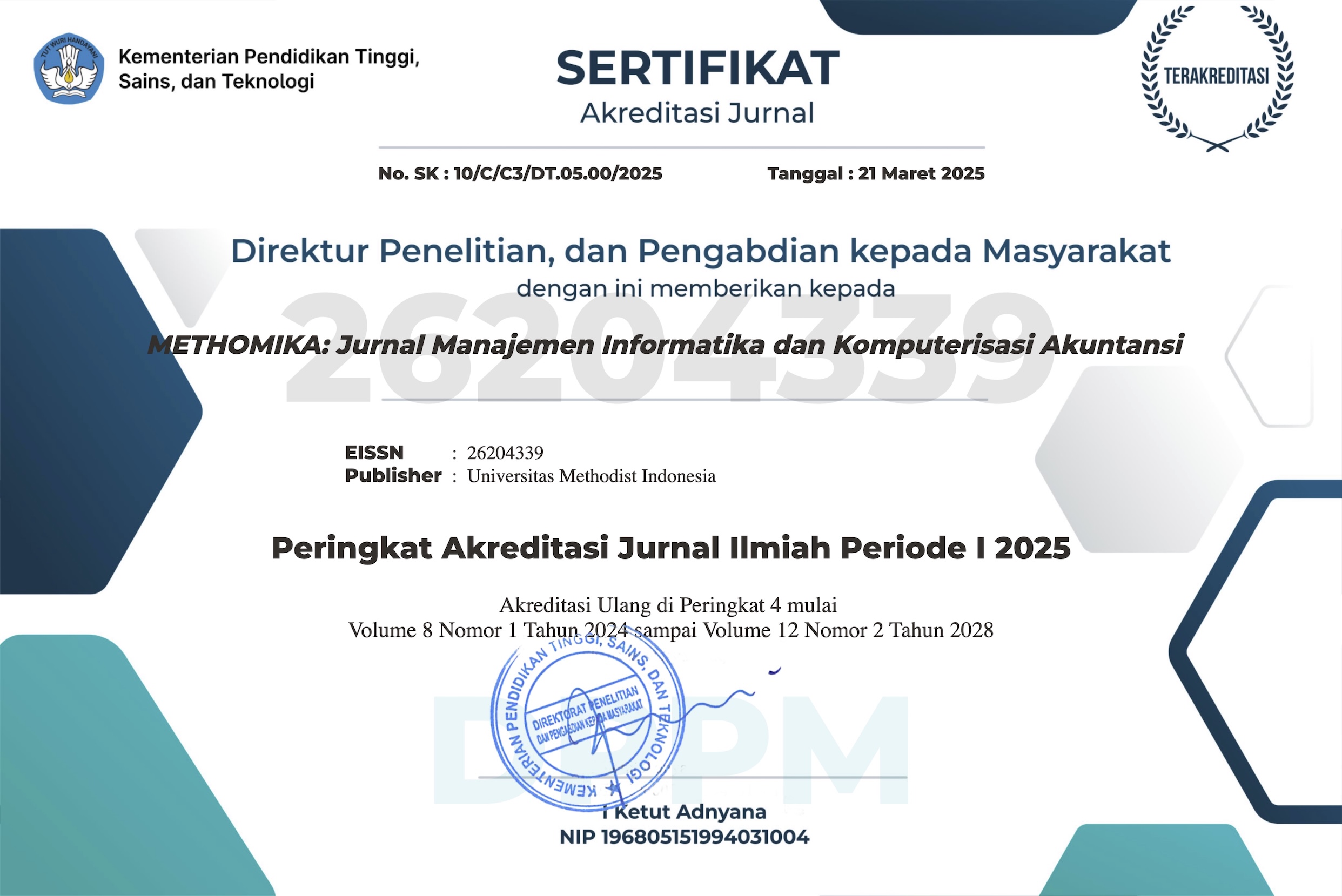
Sertifikat Akreditasi

METHOMIKA | EDITORIAL POLICY
Protecting originality, academic honesty, and research integrity in scholarly publishing.
METHOMIKA: Jurnal Manajemen Informatika & Komputerisasi Akuntansi, published by Universitas Methodist Indonesia, is committed to maintaining originality, academic honesty, transparency, and scientific integrity in all scholarly publications.
The journal does not tolerate plagiarism, inappropriate text recycling, misleading attribution, or unauthorized reproduction of intellectual works. All submitted manuscripts must represent original scholarly contributions and appropriately acknowledge relevant sources.
This policy is informed by the publication ethics principles recommended by the Committee on Publication Ethics (COPE) and the journal's established editorial requirements.
Below 20%
Manuscripts must meet this requirement before proceeding to peer review.
A similarity score measures text overlap with existing sources. It does not automatically establish the presence or absence of plagiarism. The editorial team considers the matched sources, citation practices, extent of overlap, and context of reused material.
Plagiarism involves presenting another person's words, ideas, research findings, data, methods, images, tables, software code, or other intellectual contributions as one's own without appropriate acknowledgment or attribution. Plagiarism may occur intentionally or through improper academic writing practices.
Copying text, paragraphs, or substantial portions of another work without proper quotation and source acknowledgment.
Rewriting another author's ideas or statements without proper attribution, even when the original wording has been changed.
Combining phrases, sentence structures, or passages from multiple sources without appropriate quotation or acknowledgment.
Presenting another researcher's concepts, models, hypotheses, methods, or original intellectual contributions as one's own.
Using datasets, figures, visual materials, algorithms, or software code developed by others without appropriate attribution or permission when required.
Reusing substantial portions of an author's previously published work without appropriate disclosure, citation, or justification.
Publishing or submitting substantially overlapping research in multiple journals without proper disclosure or an acceptable scholarly justification.
All submitted manuscripts are subject to originality screening before entering the peer review stage. Similarity checking is conducted using the similarity detection software designated by the editorial team.
In accordance with the journal's Author Guidelines, manuscripts must have an overall similarity score below 20% to proceed to peer review.
The editorial team evaluates similarity reports by examining matched passages, original sources, citation accuracy, quotations, and the nature of reused materials. Reasonable exclusions for references or properly quoted material may be applied consistently according to the journal's screening procedures.
Authors submit original manuscripts through the journal's OJS platform.
Editors assess submission completeness, citation practices, and potential originality concerns.
The manuscript is examined using the journal's designated similarity detection software.
Editors examine the similarity report, matched sources, citation quality, and relevant manuscript sections.
Authors may be asked to clarify identified similarities and revise problematic passages or citations.
Revised manuscripts may undergo another similarity assessment before further editorial processing.
Editors determine whether the manuscript may proceed to peer review, requires further clarification, or should be rejected.
| Screening Result | Editorial Action |
|---|---|
| Below 20% | The manuscript may proceed to the next editorial stage if no plagiarism or other serious ethical concerns are identified. |
| 20% or higher | The manuscript does not meet the similarity requirement for peer review. Revision, clarification, re-screening, or rejection may be considered. |
| Substantial plagiarism suspected | The editorial team examines the evidence and requests clarification when appropriate. A manuscript may be rejected regardless of its similarity percentage. |
Similarity percentages must be interpreted alongside the nature and significance of matched content.
Authors are responsible for ensuring the originality and academic integrity of their submitted manuscripts. Authors must:
Editors are responsible for evaluating potential plagiarism objectively, fairly, and on the basis of available evidence. Editorial decisions must consider the significance of the overlap and any explanations provided by the authors.
Reviewers should notify the editorial team when they identify substantial similarities, unattributed sources, duplicated research, or other suspected integrity violations. All parties must maintain the confidentiality of unpublished manuscripts and editorial records.
When suspected plagiarism is identified, the editorial team will evaluate the evidence, the severity of the concern, and the author's explanation before determining appropriate action.
Editorial actions should be proportionate to the nature and seriousness of the violation and based on documented evidence.
Allegations of plagiarism identified after publication will be assessed by the editorial team in accordance with the journal's publication ethics and correction and retraction policies.
Depending on the findings, appropriate editorial actions may include:
Any formal notice should clearly identify the affected article and remain accessible to readers.
The use of artificial intelligence tools does not remove authors' responsibilities for originality, accurate citations, methodological transparency, and research integrity.
Authors must disclose substantive AI assistance in accordance with the journal's policy. AI tools must not be used to fabricate references, misrepresent research findings, reproduce copyrighted materials without appropriate authorization, or conceal plagiarism.
Effective from Volume 11, Number 1 (April 2027), all manuscripts intended for publication in METHOMIKA must be written entirely in English. Editorial correspondence, reviewer comments, author responses, manuscript revisions, and scholarly discussions must also be conducted in English.
Committee on Publication Ethics (COPE). Publication Ethics Guidelines and Resources.
METHOMIKA. Author Guidelines.
METHOMIKA: Jurnal Manajemen Informatika & Komputerisasi Akuntansi
Published by Universitas Methodist Indonesia
Publication Frequency: April and October
Official Journal Website
AKREDITASI
Sertifikat Akreditasi

METHOMIKA: Jurnal Manajemen Informatika & Komputerisasi Akuntansi
is licensed under a Creative Commons Attribution-NonCommercial 4.0 International License (CC BY-NC 4.0)