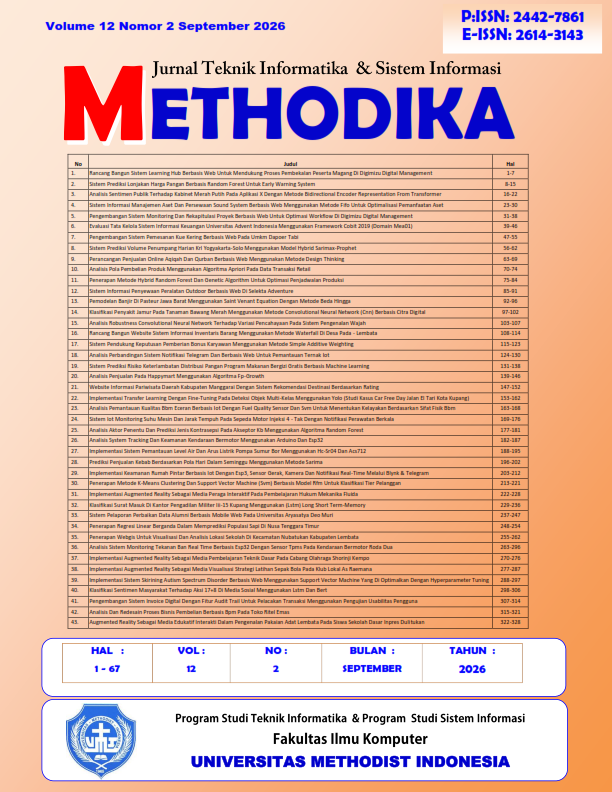
ANALISIS SYSTEM TRACKING DAN KEAMANAN KENDARAAN BERMOTOR MENGGUNAKAN ARDUINO DAN ESP32
DOI:
https://doi.org/10.46880/mtk.v12i2.5974Keywords:
ESP32, Arduino Uno R3, GPS U-Blox Neo M8N, SIM7600, IoT Vehicle TrackingAbstract
Motor vehicle theft remains a leading criminal offense in Indonesia, highlighting the high vulnerability of factory-standard security systems. This situation underscores the urgent need for more adaptive technological innovations to enhance security and enable real-time vehicle tracking. This research focuses on developing an Internet of Things (IoT)-based vehicle security system integrated with location tracking capabilities. The study addresses the lack of an optimal comparative analysis regarding the performance of commonly used microcontrollers specifically the Arduino Uno and ESP32 within the context of tracking systems. System performance is evaluated based on three key parameters: GPS tracking accuracy (timestamp), data transmission latency (response time), and microcontroller power consumption efficiency. The findings aim to identify the superior and more efficient microcontroller platform, serving as a crucial reference for developers and researchers creating reliable, fast, and energy-efficient IoT-based vehicle security systems. The results indicate that the ESP32 outperforms the Arduino Uno R3; although the ESP32 exhibits higher power consumption and slightly lower location accuracy than the Arduino Uno R3, it offers a significant advantage: the ability to manage the SIM7600 module's functions and transmit data to the Blynk dashboard online capabilities that the Arduino Uno R3 lacks.
References
L. Abudi, M. Tahir, and S. F. L., “Faktor-Faktor Penyebab Terjadinya Pencurian Kendaraan Bermotor (Suatu Studi di Wilayah Hukum Polres Buton),” Sultra Law Rev., vol. 2, no. 1, pp. 891–910, 2020.
A. A. Elkhail, R. U. D. Refat, R. Habre, A. Hafeez, A. Bacha, and H. Malik, “Vehicle Security: A Survey of Security Issues and Vulnerabilities, Malware Attacks and Defenses,” IEEE Access, vol. 9, pp. 162401–162437, 2021, doi: 10.1109/ACCESS.2021.3130495.
A. A. Elngar and M. Kayed, “Vehicle Security Systems using Face Recognition based on Internet of Things,” Open Comput. Sci., vol. 10, no. 1, pp. 17–29, 2020, doi: 10.1515/comp-2020-0003.
A. Rehman, T. Saba, K. Haseeb, G. Jeon, and T. Alam, “Modeling and Optimizing IoT-Driven Autonomous Vehicle Transportation Systems Using Intelligent Multimedia Sensors,” Multimed. Tools Appl., vol. 84, no. 29, pp. 35427–35441, 2025, doi: 10.1007/s11042-023-15563-y.
A. S. Ismailov and Z. B. Jo’rayev, “Study of Arduino Microcontroller Board,” Sci. Educ., vol. 3, no. 3, pp. 172–179, 2022.
D. Hercog, T. Lerher, M. Truntič, and O. Težak, “Design and Implementation of ESP32-Based IoT Devices,” Sensors, vol. 23, no. 15, p. 6739, 2023, doi: 10.3390/s23156739.
Siswanto, R. N. Hay, and F. R. Bahari, “Implementasi Sistem Keamanan Kendaraan Bermotor Menggunakan GPS Berbasis IoT,” STRING (Satuan Tulisan Ris. dan Inov. Teknol., vol. 9, no. 2, pp. 215–221, 2024, doi: 10.30998/string.v9i2.25928.
A. H. H. Jabastian, K. Erwansyah, M. S. Wahyuni, and S. N. Arif, “Monitoring Anti Maling Sepeda Motor Menggunakan IOT Berbasis NodeMCU,” J. Sist. Komput. Triguna Dharma (JURSIK TGD), vol. 2, no. 1, pp. 34–42, 2023, doi: 10.53513/jursik.v2i1.7045.
M. Alagarsamy, P. Kasinathan, G. Manickam, P. R. Duruvarajan, J. Sakkarai, and K. Suriyan, “IoT Based E-Vehicle Monitoring System Using Sensors and Imaging Processing Algorithm,” Int. J. Reconfigurable Embed. Syst., vol. 11, no. 2, pp. 196–204, 2022, doi: 10.11591/ijres.v11.i2.pp196-204.
A. A. B. Azlina Idris, Muhamad Nor Iman, Siti Maisurah Sulong, Wan Norsyafizan W. Muhamad, “Vehicle Tracking System Based on Internet of Things Utilizing TTGO T-,” J. Robot. Control, vol. 2, no. 2, pp. 118–127, 2025.
A. Idris, W. N. W. Muhamad, M. N. Iman, S. M. Sulong, and A. Abu Bakar, “Vehicle Tracking System Based on Internet of Things Utilizing TTGO T-CALL ESP32 SIM800l,” J. Adv. Res. Appl. Sci. Eng. Technol., vol. 45, no. 2, pp. 118–127, 2025, doi: 10.37934/araset.45.2.118127.
F. A. Aryatama and S. Samsugi, “Sistem Keamanan Kendaraan Bermotor Dengan ESP32 Menggunakan Kontrol Android,” SMATIKA STIKI Inform. J., vol. 14, no. 1, pp. 167–181, 2024, doi: 10.32664/smatika.v14i01.1267.
M. Juliarto, R. A. Nityasa, and A. D. F. Aditama, “Perancangan Keamanan Kendaraan Tanpa Kunci Dengan Menggunakan ESP32 dan Aplikasi BLYNK Berbasis IOT,” V-MAC (Virtual Mech. Eng. Artic., vol. 9, no. 1, pp. 47–53, 2024, doi: 10.36526/v-mac.v9i1.3653.
F. F. Musyafa, S. Pamuji, and H. Nasrullah, “Sistem Keamanan Sepeda Motor Mio GT Berbasis Arduino Uno dan RFID,” Auto Tech J. Pendidik. Tek. Otomotif Univ. Muhammadiyah Purworejo, vol. 16, no. 2, pp. 174–186, 2021, doi: 10.37729/autotech.v16i2.1190.
S. Villamil, C. Hernández, and G. Tarazona, “An overview of internet of things,” Telkomnika (Telecommunication Comput. Electron. Control., vol. 18, no. 5, pp. 2320–2327, 2020, doi: 10.12928/TELKOMNIKA.v18i5.15911.
I. G. S. Widharma and L. F. Wiranata, Mikrokontroler dan Aplikasi. Media Nusa Creative (MNC Publishing).
J. Suto, “A Novel Plug-in Board for Remote Insect Monitoring,” Agriculture, vol. 12, no. 11, p. 1897, 2022, doi: 10.3390/agriculture12111897.
Firdaus and Ismail, “Komparasi Akurasi Global Posistion System (GPS) Receiver U-blox Neo-6M dan U-blox Neo-M8N pada Navigasi Quadcopter,” Elektron J. Ilm., vol. 12, no. 1, pp. 12–15, 2020, doi: 10.30630/eji.12.1.137.
E. Johansson, “Current Sensing in Software for Electronic Fuse Applications: Analysis of Two Different Current Measurement Implementations,” KTH Royal Institute of Technology, Stockholm, Sweden, 2021.
W. Li, “Power Bank,” 2024
Downloads
Published
How to Cite
Issue
Section
License
Copyright (c) 2026 William Sanro Umbu Muda, Mehya Snae, Yohanis Malelak

This work is licensed under a Creative Commons Attribution 4.0 International License.