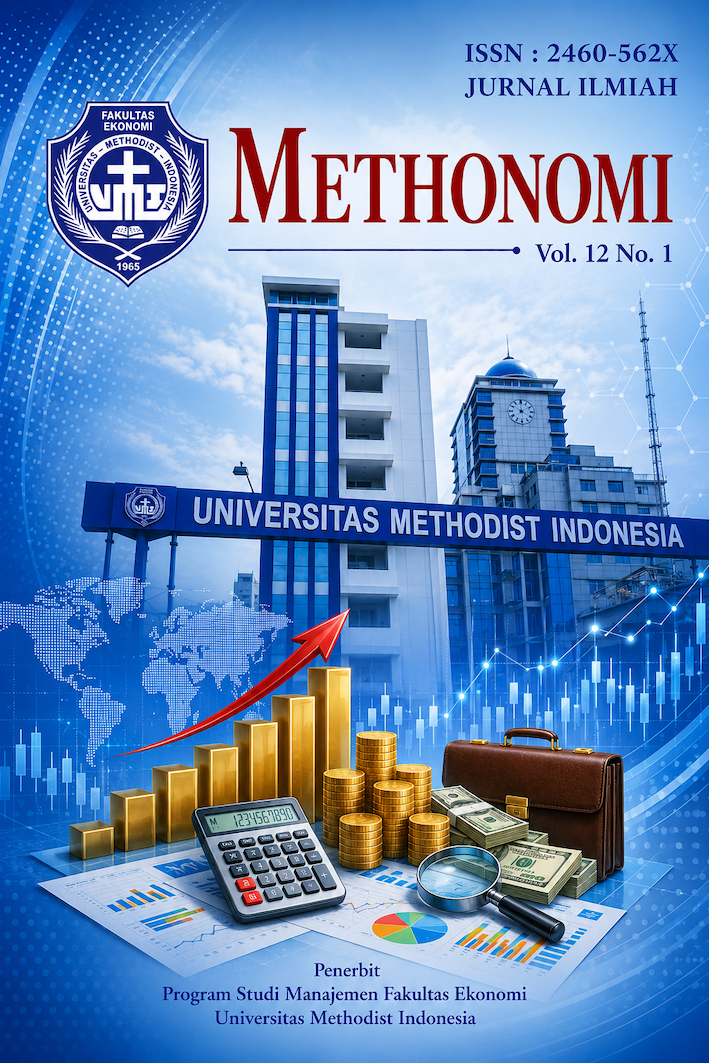
Analisis Kombinasi Faktor Asal Sekolah dan Jurusan Terhadap Pilihan Program Studi Calon Mahasiswa Baru STMIK Kaputama
Strategi Data-Driven untuk Optimalisasi Penerimaan Mahasiswa Baru
DOI:
https://doi.org/10.46880/methonomi.Vol12No1.pp15-29Keywords:
Data-Driven Strategy, Educational Background, SegmentationAbstract
This study aims to analyze the combined effect of school origin and academic major on study program choices of prospective students, as well as to formulate data-driven admission strategies. The research gap lies in the limited use of historical enrollment data to examine the relationship between educational background and study program selection, particularly in private higher education institutions. This study employs a descriptive quantitative approach with a correlational design using secondary data from 1,462 applicants over five academic years (2021–2026) at STMIK Kaputama. Data were analyzed using descriptive statistics, cross-tabulation, and segmentation analysis. The results indicate a significant relationship between educational background and study program selection. Information Systems emerges as the most preferred program across all segments, while Informatics Engineering is more dominant among vocational graduates with technical backgrounds such as TKJ and RPL. Furthermore, three main segments were identified: academic (SMA), vocational technology (SMK TKJ/RPL), and transition segments (non-technical SMK and MA). The study concludes that student admission strategies should shift from mass marketing to segmented, data-driven approaches to improve effectiveness and institutional competitiveness.
Downloads
Published
Issue
Section
License
Copyright (c) 2026 Lina Arliana Nur Kadim, Suci Ramadani

This work is licensed under a Creative Commons Attribution-NonCommercial 4.0 International License.