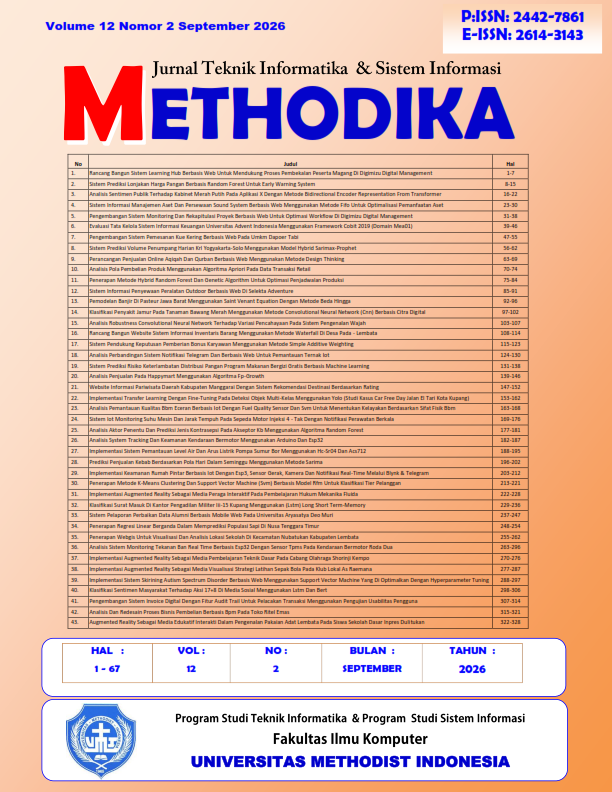
IMPLEMENTASI SISTEM SKIRINING AUTISM SPECTRUM DISORDER BERBASIS WEB MENGGUNAKAN SUPPORT VECTOR MACHINE YANG DI OPTIMALKAN DENGAN HYPERPARAMETER TUNING
DOI:
https://doi.org/10.46880/mtk.v12i2.6149Keywords:
Autism Spectrum Disorder, Support Vector Machine, Q-CHAT-10, Early Detection, Screening SystemAbstract
Autism Spectrum Disorder (ASD) is a neurodevelopmental disorder that affects communication, social interaction, and behavior in children. Early detection of ASD is crucial because early intervention has been proven to improve children's adaptive abilities. However, the screening process in Indonesia is still conducted conventionally through observation and interviews, which require considerable time and are highly subjective. This study aims to implement a prototype web-based ASD screening system using a Support Vector Machine (SVM) optimized through feature selection and hyperparameter tuning. The dataset used is the Autism Child Screening Data (n=292) with 22 initial variables covering demographic data and Q-CHAT-10 screening results. The class distribution is relatively balanced, with 151 Normal (51.7%) and 141 Autism (48.3%) samples. The research stages include data preprocessing, feature selection using four methods (correlation, Mutual Information, ANOVA F-score, and Permutation Importance), hyperparameter tuning with GridSearchCV 10-fold cross-validation, model training, evaluation, and web-based system implementation using Streamlit. The results show that the SVM model with the RBF kernel, parameters C=10.0, gamma=0.01, and class weight {0:1.0, 1:3.0}, achieved an accuracy of 94.83%, a precision of 100% for the Normal class and 90.32% for the Autism class, a recall of 90% for Normal and 100% for Autism, an F1-score of 0.95 for both classes, and an ROC-AUC of 0.9940. The model is implemented in a web prototype that can be used as an early screening aid for healthcare professionals. This research contributes to the development of a machine learning-based decision support system integrated with clinical knowledge through the Q-CHAT-10 cut-off post-processing rule.
References
C. S. Hiremath et al., “Emerging behavioral and neuroimaging biomarkers for early and accurate characterization of autism spectrum disorders: a systematic review,” Transl. Psychiatry, vol. 11, no. 1, 2021, doi: 10.1038/s41398-020-01178-6.
H. & Coyle, “Autism spectrum disorder,” Neurobiol. Brain Disord. Biol. Basis Neurol. Psychiatr. Disord. Second Ed., vol. 6, no. 1, pp. 69–88, 2022, doi: 10.1016/B978-0-323-85654-6.00016-2.
Tim Riset Dinas Kesehatan, “Laporan Riskesdas 2018 Nasional.pdf,” 2018.
Farahdina, Irwanto, and I. Fithriyah, “Risk factors for autism spectrum disorder diagnosed in Indonesia,” Child’s Heal., vol. 20, no. 5, pp. 325–332, 2025, doi: 10.22141/2224-0551.20.5.2025.1866.
P. Ghazi, Ridwan Achmad, and A. Prihandono, “D d a ( a s d ) m m l,” vol. 4, no. 2, pp. 44–51, 2023.
M. A. Putri, Chrystia Aji Putra, and Wahyu Syaifullah Jauharis Saputra, “Diagnosis Awal Autism Spectrum Disorder Menggunakan Algoritma Fuzzy K-Nearest Neighbor,” J. Inform. Teknol. dan Sains, vol. 6, no. 2, pp. 182–187, 2024, doi: 10.51401/jinteks.v6i2.3463.
G. Tartarisco et al., “Use of machine learning to investigate the quantitative checklist for autism in toddlers (Q-CHAT) towards early autism screening,” Diagnostics, vol. 11, no. 3, 2021, doi: 10.3390/diagnostics11030574.
J. Jovel and R. Greiner, “An Introduction to Machine Learning Approaches for Biomedical Research,” Front. Med., vol. 8, no. December, pp. 1–15, 2021, doi: 10.3389/fmed.2021.771607.
A. Novianto and Mila Desi Anasanti, “Identification of Autism Spectrum Disorder (ASD) using Feature-based Machine Learning Classification Model,” 2nd Int. Conf. Sustain. Comput. Smart Syst. ICSCSS 2024 - Proc., vol. 17, no. 3, pp. 1378–1384, 2024, doi: 10.1109/ICSCSS60660.2024.10625207.
M. Y. Yeap, S. Chua, and A. Bramantoro, “A Comparative Analysis of Machine Learning Models for Prediction of Autism Spectrum Disorder Using Screening Data,” J. Adv. Res. Appl. Sci. Eng. Technol., vol. 53, no. 1, pp. 175–185, 2025, doi: 10.37934/araset.53.1.175185.
F. Mainas, B. Golosio, A. Retico, and P. Oliva, “Exploring Autism Spectrum Disorder: A Comparative Study of Traditional Classifiers and Deep Learning Classifiers to Analyze Functional Connectivity Measures from a Multicenter Dataset,” Appl. Sci., vol. 14, no. 17, 2024, doi: 10.3390/app14177632.
O. A. Montesinos López, A. M. López, and J. Crossa, Multivariate Statistical Machine Learning Methods for Genomic Prediction. 2022. doi: 10.1007/978-3-030-89010-0.
L. N. Farida and S. Bahri, “Klasifikasi Gagal Jantung menggunakan Metode SVM (Support Vector Machine),” Komputika J. Sist. Komput., vol. 13, no. 2, pp. 149–156, 2024, doi: 10.34010/komputika.v13i2.11330.
S. Saifuddin, L. Azhari, E. Widarti, and W. Wartono, “Evaluasi Kinerja Kernel Linear, RBF, dan Polynomial pada Model Support Vector Machine untuk Prediksi Risiko Hipertensi,” J. Ilm. FIFO, vol. 17, no. 2, p. 192, 2025, doi: 10.22441/fifo.2025.v17i2.008.
L. Alaika, “Optimization of Accuracy to Autism Spectrum Disorder Identification for Children Using Support Vector Machine and Correlation-based Feature Selection,” J. Adv. Inf. Syst. Technol., vol. 4, no. 1, pp. 1–12, 2022, [Online]. Available: https://journal.unnes.ac.id/sju/index.php/jaist
N. A. Mashudi, N. Ahmad, and N. M. Noor, “Classification of adult autistic spectrum disorder using machine learning approach,” IAES Int. J. Artif. Intell., vol. 10, no. 3, pp. 743–751, 2021, doi: 10.11591/ijai.v10.i3.pp743-751.
D. L. Floris et al., “The Link Between Autism and Sex-Related Neuroanatomy, and Associated Cognition and Gene Expression,” Am. J. Psychiatry, vol. 180, no. 1, pp. 50–64, 2023, doi: 10.1176/APPI.AJP.20220194.
C. P. SANTANA, “A meta-analysis of machine learning classification tools using rs-fmri data for autism spectrum disorder diagnosis,” 2021, [Online]. Available: https://repositorio.unifei.edu.br/jspui/handle/123456789/2370
Downloads
Published
How to Cite
Issue
Section
License
Copyright (c) 2026 Adam Galuh Bhakti, Brestina Gultom

This work is licensed under a Creative Commons Attribution 4.0 International License.