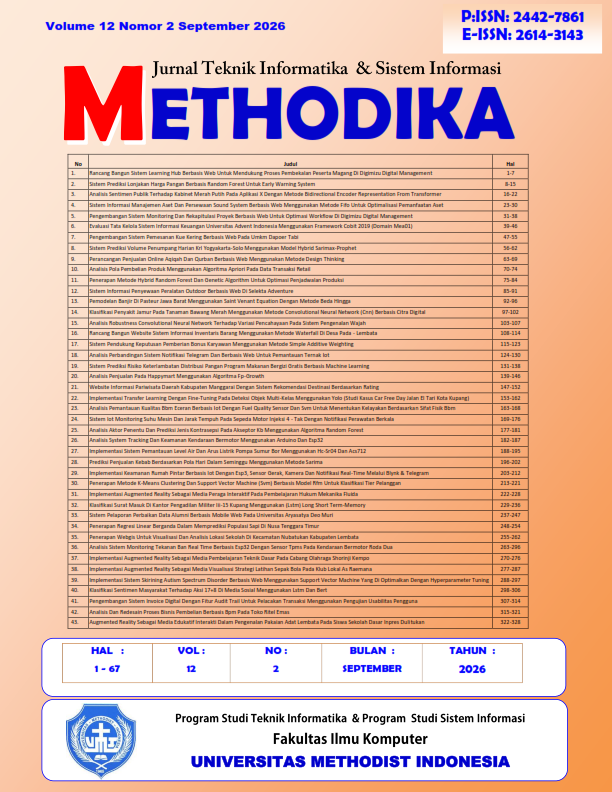
ANALISIS ROBUSTNESS CONVOLUTIONAL NEURAL NETWORK TERHADAP VARIASI PENCAHAYAAN PADA SISTEM PENGENALAN WAJAH
DOI:
https://doi.org/10.46880/mtk.v12i2.5833Keywords:
Convolutional Neural Network, Face Recognition, Fast Gradient Sign Method, Illumination Robustness, K-Fold Cross ValidationAbstract
This study aims to evaluate the robustness of Convolutional Neural Networks (CNN) in face recognition systems under varying illumination conditions. The evaluation was conducted using a dataset comprising 36 subjects, with facial images captured under three distinct lighting scenarios: dim, normal, and bright. The research methodology involved training the CNN model using K-Fold Cross-Validation and assessing its stability against visual disturbances using artificial adversarial attacks based on the Fast Gradient Sign Method (FGSM). The novelty and main contribution of this study lie in the dual-evaluation approach, which simultaneously tests the model's resilience against natural illumination variations and artificial adversarial perturbations. Experimental results demonstrated that the CNN model achieved optimal face recognition performance at 50 epochs, maintaining an average accuracy rate of 81.48%. In conclusion, the evaluated CNN architecture is reliable and stable for face recognition in uncontrolled lighting environments, providing a solid foundation for developing more secure biometric systems against visual disturbances.
References
N. Dewi and F. Ismawan, “Implementasi Deep Learning Menggunakan Cnn Untuk Sistem Pengenalan Wajah,” Fakt. Exacta, vol. 14, no. 1, p. 34, 2021, doi: 10.30998/faktorexacta.v14i1.8989.
K. Anwar, “Sistem Deteksi Wajah Berbasis Deep Learning Menggunakan Convolutional Neural Network ( CNN ),” vol. 1, no. 2, pp. 46–52, 2025, doi:
A. Khalifa, A. A. Abdelrahman, T. Hempel, and A. Al-Hamadi, “Towards efficient and robust face recognition through attention-integrated multi-level CNN,” Multimed. Tools Appl., vol. 84, no. 14, pp. 12715–12737, 2025, doi: 10.1007/s11042-024-19521-0.
B. Nugroho, “Pengaruh Perubahan Ukuran Citra terhadap Kinerja Metode Robust Regression pada Pengenalan Wajah,” vol. 2, pp. 188–191, 2021, doi:
L. P. A. S. T. Setiawan, I Nyoman Yoga, “Optimization of Face Recognition Systems With Image Processing,” J. Komput. dan Teknol. Sains, vol. 3, no. 1, pp. 18–22, 2024, doi:
R. I. Bendjillali, M. Beladgham, K. Merit, and A. Taleb-Ahmed, “Illumination-robust face recognition based on deep convolutional neural networks architectures,” Indones. J. Electr. Eng. Comput. Sci., vol. 18, no. 2, pp. 1015–1027, 2020, doi: 10.11591/ijeecs.v18.i2.pp1015-1027.
R. A. Tilasefana and R. E. Putra, “Penerapan Metode Deep Learning Menggunakan Algoritma CNN Dengan Arsitektur VGG Net Untuk Pengenalan Cuaca,” J. Informatics Comput. Sci., vol. 5, no. 01, pp. 48–57, 2023, [Online]. Available: https://ejournal.unesa.ac.id/index.php/jinacs/article/view/54515
L. Yang, B. Yang, and X. Gu, “Adversarial Reconstruction CNN for Illumination-Robust Frontal Face Image Recovery and Recognition,” vol. 15, no. 2, 2021, doi: 10.4018/IJCINI.20210401.oa2.
N. A. Rahmatika, M. Oktiana, and F. Arnia, “Cross-Spectral Cross-Distance Face Recognition via CNN with Image Augmentation Techniques,” J. RESTI, vol. 8, no. 5, pp. 665–673, 2024, doi: 10.29207/resti.v8i5.5929.
Downloads
Published
How to Cite
Issue
Section
License
Copyright (c) 2026 Ezra Ananta Pandie, Franki Yusuf Bisilisin, Dewi Anggraini

This work is licensed under a Creative Commons Attribution 4.0 International License.