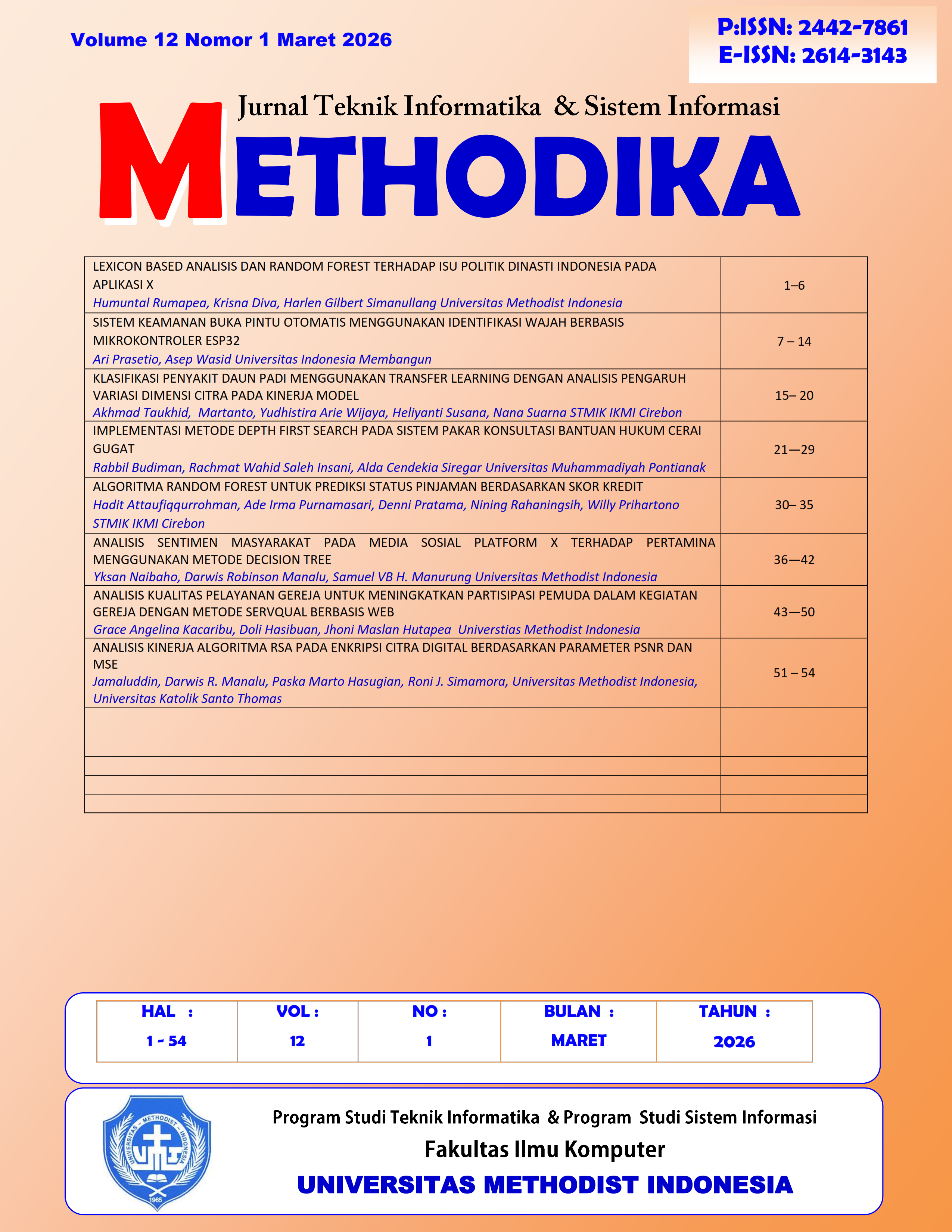
ANALISIS KUALITAS PELAYANAN GEREJA UNTUK MENINGKATKAN PARTISIPASI PEMUDA DALAM KEGIATAN GEREJA DENGAN METODE SERVQUAL BERBASIS WEB
DOI:
https://doi.org/10.46880/mtk.v12i1.5291Keywords:
Service Quality, SERVQUAL, Church Youth, WebAbstract
Service quality is a crucial factor in maintaining congregational participation, especially among youth. Changing trends and technological developments have led the younger generation to expect innovative, accessible, and responsive services. Services that fail to meet expectations can decrease their participation in church activities. This study was conducted in the Els Generation youth community of GPdI El-Shaddai Medan with the aim of analyzing the quality of church services using the SERVQUAL method and designing a web-based application to facilitate evaluation. Data were collected through an online questionnaire from 100 respondents, supplemented by interviews and observations. Analysis was conducted on five SERVQUAL dimensions: tangibles, reliability, responsiveness, assurance, and empathy to measure the gap between expectations and perceptions. The results showed that the four main dimensions—Tangibles (-0.10), Reliability (-0.12), Responsiveness (-0.08), and Assurance (-0.07)—had a negative gap, indicating that church services have not fully met youth expectations. Only the Empathy dimension (+0.05) had a positive gap, indicating the church's strength in personal care and attention. The dimension with the largest negative gap was Reliability (-0.12), indicating a need for improvement in aspects of service reliability, such as activity consistency and schedule certainty. The developed web-based application facilitated data collection, gap calculations, and the presentation of analysis results automatically and efficiently.
References
E. P. Maulidiah, S. Survival, and B. Budiantono, “Pengaruh Fasilitas Terhadap Kualitas Pelayanan Serta Implikasinya Pada Kepuasan Pelanggan,” J. Econ., vol. 2, no. 3, pp. 727–737, 2023, doi: 10.55681/economina.v2i3.375.
H. Kornelis, “Strategi Pemimpin Rohani Meningkatkan Kualitas Pelayanan Di Era Digital: Tinjauan Model Pelayanan yang Efektif,” SHAMAYIM J. Teol. dan Pendidik. Kristen, vol. 3, no. 2, pp. 65–85, 2024.
P. R. Prihans and W. Sulistiyowati, “Analisis Kepuasan Pelanggan Gojek Di Pandaan Menggunakan Metode Structural Equation Modelling ( SEM ),” Semin. Nas. Inov. Teknol., pp. 35–40, 2022.
R. Ruheli, “Universitas Galuh,” Repository.Unigal.Ac.Id, pp. 20–29, 2022.
C. Wijaya, Pratomo Setiaji, and Muhammad Arifin, “Implementasi Sistem Web Untuk Menilai Kepuasan Pelanggan Pt Yohom Solution Indonesia Dengan Metode Servqual,” JEKIN - J. Tek. Inform., vol. 5, no. 1, pp. 421–431, 2025, doi: 10.58794/jekin.v5i1.1318.
J. Sembiring, “Implementasi Serqual Dalam Menentukan Tingkat Kepuasan Masyarakat Terhadap Pelayanan Pengurusan Surat Izin Usaha Mikro Dan Kecil Pada Kantor Camat Dolat Rakyat Kabupaten Karo,” J. Multimed. dan Teknol. Inf., vol. 2, no. 2, pp. 74–83, 2020, doi: 10.54209/jatilima.v2i2.43.
A. F. Hadining, “Analisis Kualitas Pelayanan Terhadap Pelanggan Dengan Metode Service Quality (Servqual) dan Customer Satisfaction Index (CSI),” J@ti Undip J. Tek. Ind., vol. 15, no. 1, pp. 1–10, 2020, [Online]. Available: https://doi.org/10.14710/jati.15.1.1-10.
J. N. Gloriano, “Does Hospital Size Affect Patient Satisfaction?,” J. Pendidik. Adm. Perkantoran, vol. 26, no. 4, pp. 205–209, 2022, doi: 10.1097/QMH.0000000000000149.
T. R. C., Model SERVQUAL atau Gaps Model. Rudyct e-Press, 2025.
T. Moladia and T. Kristiana, “Penerapan Metode Importance Performance Analysis (Ipa) Untuk Menganalisis Kualitas Aplikasi Tokopedia Berdasarkan Kepuasan Pelanggan,” Komputa J. Ilm. Komput. dan Inform., vol. 12, no. 1, pp. 9–18, 2023, doi: 10.34010/komputa.v12i1.8964.
Downloads
Published
How to Cite
Issue
Section
License
Copyright (c) 2026 Grace Angelina Kacaribu, Doli Hasibuan, Jhoni Maslan

This work is licensed under a Creative Commons Attribution 4.0 International License.