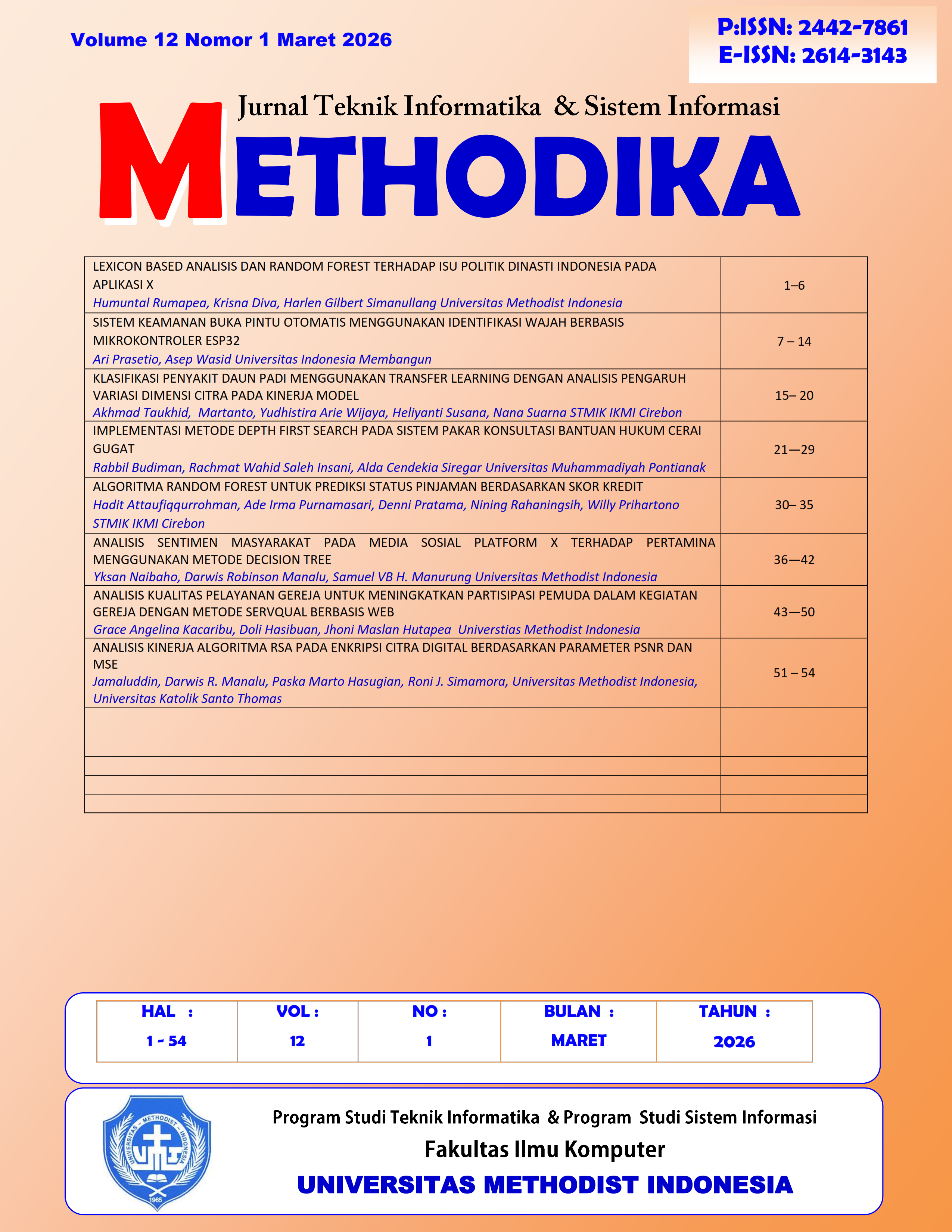
LEXICON BASED ANALISIS DAN RANDOM FOREST TERHADAP ISU POLITIK DINASTI INDONESIA PADA APLIKASI X
DOI:
https://doi.org/10.46880/mtk.v12i1.4700Keywords:
Dynastic Politics, Lexicon Based, Random Forest, Sentiment AnalysisAbstract
Dynastic politics in Indonesia remains a widely discussed issue, eliciting diverse public opinions ranging from support as a political right to criticism of democratic quality, with social media, particularly the X platform, serving as an important venue for public sentiment analysis. This study employs a combination of the Lexicon Based method using the InSet Lexicon and the Random Forest algorithm to analyze public sentiment on dynastic politics. The dataset consists of 1,593 tweets collected from August 1 to December 24, 2024, which underwent text preprocessing, labeling into three sentiment categories: positive, negative, and neutral, and word weighting using TF-IDF. The methodology includes splitting the data into training and testing sets with an 80:20 ratio, applying undersampling on the training data to balance class distribution, and training a Random Forest model with 100 decision trees and a maximum depth of 5 per tree, based on the entropy criterion. Evaluation results show that the model successfully classifies public sentiment with an accuracy of 89%, precision of 82%, recall of 81%, and f1-score of 81%.
References
A. Dedi, “Politik Dinasti dalam Perspektif Demokrasi,” Jurnal MODERAT, vol. 8, no. 1, 2022.
E. Darwisah Harahap and R. Kurniawan, “Analisis Sentimen Komentar Terhadap Kebijakan Pemerintah Mengenai Tabungan Perumahan Rakyat (TAPERA) Pada Aplikasi X Menggunakan Metode Naïve Bayes,” 2024.
D. Musfiroh, U. Khaira, P. Eko, P. Utomo, and T. Suratno, “Analisis Sentimen terhadap Perkuliahan Daring di Indonesia dari Twitter Dataset Menggunakan InSet Lexicon,” vol. 1, pp. 24–33, 2021.
E. Saputro and D. Rosiyadi, “Bianglala Informatika Penerapan Metode Random Over-Under Sampling Pada Algoritma Klasifikasi Penentuan Penyakit Diabetes,” vol. 10, no. 1, p. 2022, 2022, [Online]. Available: https://archive.ics.uci.edu/ml/machine-learning-
D. R. Manalu, M. C. L. Tobing, and M. Yohanna, “Analisis Sentimen Twitter Terhadap Wacana Penundaan Pemilu Dengan Metode Support Vector Machine,” vol. 6, no. 2, pp. 149–156, 2024.
M. F. Y. Herjanto and C. Carudin, “Analisis Sentimen Ulasan Pengguna Aplikasi Sirekap pada Play Store Menggunakan Algoritma Random Forest Classifier,” Jurnal Informatika dan Teknik Elektro Terapan, vol. 12, no. 2, Apr. 2024, doi: 10.23960/jitet.v12i2.4192.
S. Nanda, D. Mualfah, and D. A. Fitri, “Analisis Sentimen Kepuasan Pengguna Terhadap Layanan Streaming Mola Menggunakan Algoritma Random Forest,” 2022.
F. A. Larasati, D. E. Ratnawati, and B. T. Hanggara, “Analisis Sentimen Ulasan Aplikasi Dana dengan Metode Random Forest,” 2022. [Online]. Available: http://j-ptiik.ub.ac.id
S. Agung, “Implementasi Text Mining untuk Analisis Review pada Aplikasi Crowdfunding LX dan ST Menggunakan Metode Sentiment Analysis Satria Agung Satria Agung,” vol. 2, no. 1, pp. 124–130, 2024, doi: 10.35870/ljit.v2i1.2245.
P. Amira Sumitro et al., “Analisis Sentimen Terhadapat Vaksin Covid-19 di Indonesia pada Twitter Menggunakan Metode Lexicon Based,” 2021, [Online]. Available: https://developer.twitter.com
F. Koto and G. Y. Rahmaningtyas, “Inset lexicon: Evaluation of a word list for Indonesian sentiment analysis in microblogs,” in Proceedings of the 2017 International Conference on Asian Language Processing, IALP 2017, Institute of Electrical and Electronics Engineers Inc., Jul. 2017, pp. 391–394. doi: 10.1109/IALP.2017.8300625.
E. Rifut Nur Mustaqim, U. Pagalay, and C. Crysdian, “Prediksi Tingkat Kepercayaan Masyarakat terhadap Pilpres 2024 Menggunakan TF-IDF dan BoW Menggunakan Metode SVM,” 2024.
R. F. Ramadhan, S. Hadi Wijoyo, and M. C. Saputra, “Penerapan Metode K-Means Clustering pada Ulasan Perumahan PT XYZ di Google Maps untuk Formulasi Strategi Bisnis dengan Analisis SWOT,” 2023. [Online]. Available: http://j-ptiik.ub.ac.id
H. Hairani, K. E. Saputro, and S. Fadli, “K-means-SMOTE for handling class imbalance in the classification of diabetes with C4.5, SVM, and naive Bayes,” Jurnal Teknologi dan Sistem Komputer, vol. 8, no. 2, pp. 89–93, Apr. 2020, doi: 10.14710/jtsiskom.8.2.2020.89-93.
Ary Prandika Siregar, Dwi Priyadi Purba, Jojor Putri Pasaribu, and Khairul Reza Bakara, “Implementasi Algoritma Random Forest Dalam Klasifikasi Diagnosis Penyakit Stroke,” Jurnal Penelitian Rumpun Ilmu Teknik, vol. 2, no. 4, pp. 155–164, Nov. 2023, doi: 10.55606/juprit.v2i4.3039.
M. E. Bastian, B. Rahayudi, and D. E. Ratnawati, “Prediksi Trend Harga Saham Jangka Pendek berdasarkan Fitur Technical Analysis dengan menggunakan Algoritma Random Forest,” 2021. [Online]. Available: http://j-ptiik.ub.ac.id
D. Normawati and S. A. Prayogi, “Implementasi Naïve Bayes Classifier Dan Confusion Matrix Pada Analisis Sentimen Berbasis Teks Pada Twitter,” 2021.
Downloads
Published
How to Cite
Issue
Section
License
Copyright (c) 2026 Krisna Diva, Humuntal Rumapea, Harlen Gilbert Simanullang

This work is licensed under a Creative Commons Attribution 4.0 International License.